Written by Daniel Scheffler |
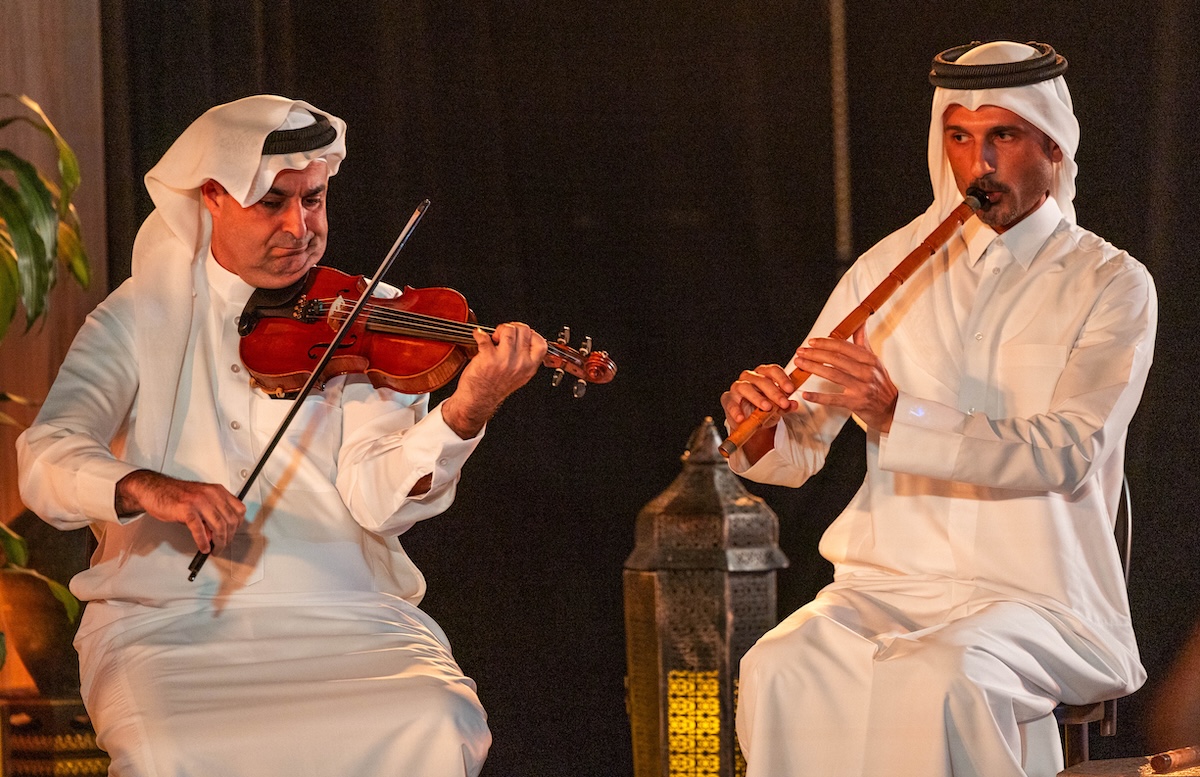
The concert series has a list of rules that reads like a manifesto against the modern age. No mobile phones. No amplification. No screens of any kind. The audience sits in close quarters, breathing the same air as the musicians, hearing every scrape of bow against string, every intake of breath before a vocal line. It’s the sort of thing that might sound precious on paper—the kind of experience that gets marketed as “authentic” without much thought to what that word actually means.
But Dr. Mustafa Said, the composer and oud player behind Qatar’s Heart to Heart series, has thought about it. Rather a lot, actually.
“In 2026, ‘authentic’ doesn’t mean abandoning our human nature in favor of technology or trends,” Said tells me. “It means returning to it. We’re seeing a global shift back toward what is organic and real. These movements reflect a greater desire to live in alignment with what sustains us, both physically and emotionally.”
It’s an unexpectedly environmental framing for a music series, but Said isn’t being merely poetic. He means it literally. “Amplifying music is like mass production in agriculture,” he explains, “or the act of adding chemicals and hormones to plants to increase production. This method succeeded in feeding more people and killing what they call agricultural diseases, but the plants lost a great portion of their benefits.” The parallel extends to sound itself: “Amplification succeeded in reaching more people, larger numbers of listeners with less effort, but the waves lost their natural harmony, authentic volume, and relationship between the performer to the listener.”
On a physical level, Said argues, something fundamental gets flattened. “What we lose is the natural complexity and spatial behavior of sound waves,” he says. “Instead of rich, organically interacting vibrations moving through space, amplification often replaces them with simplified, electronically shaped waveforms that flatten nuance and alter how sound naturally blends, resonates, and travels.”
Heart to Heart, which is a year-round affair, now in its second year under Qatar Foundation’s support, is Said’s attempt to create an alternative—not a replacement for the arena shows and festival stages that define contemporary music culture, but a parallel space where a different kind of experience becomes possible. The series draws on eight centuries of Arabic musical tradition, from historical manuscripts to newly commissioned works, all performed in settings designed for unmediated listening.
At the heart of this tradition sits maqam, the melodic system that underpins Arabic classical music. For Western audiences unfamiliar with the concept, Said offers a linguistic analogy: “Maqam is a musical system derived from language and linguistic transformational thoughts,” he explains. “Just as language uses tone, rhythm, emphasis, and subtle shifts to transform a sentence’s meaning, maqam uses melodic pathways and microtonal nuances to transform emotional expression. It’s not just a scale or a set of notes. It’s a way of thinking and communicating through sound.”
The system, Said insists, isn’t simply preserved in conservatories or academic settings. “Maqam doesn’t reside in the performer’s memory alone,” he says. “It lives in the collective memory of our nation. It is taken from how people here think, speak, pray, recite, play, and simply how they live their everyday life.”
It’s an ambitious claim—that a musical tradition could be so woven into the fabric of daily existence that it shapes thought itself.
When I ask whether there’s a risk of maqam being misunderstood or diluted as it reaches wider audiences, Said pivots to a broader distinction. “Audiences need to understand differences between classical and pop music,” he says. “That classical music develops from the inside to preserve the old, not as a monument, but as a living tradition that can have new contemporary production a generation after another.” In other words, it’s preservation through evolution rather than museumification—a delicate balance.
Said’s own work for the series reflects this approach. He composes new pieces based on historical manuscripts, many of them dating to the late 19th century. “I was most surprised by the sheer number of melodies preserved in old manuscripts,” he tells me, “far more than I expected. Equally striking was realizing that many of these records have largely been neglected.”
The series features other artists as well, each taking their own approach to the tradition. “Some of them preferred reproduction of old heritage,” Said notes, “while others are working on their own compositions.” It’s a spectrum of approaches united by the conditions of performance: the intimacy, the acoustic purity, the absence of mediation.
Said’s thinking about sound extends beyond music to natural phenomena. “It is simply following the natural intervals of a wave, the natural topography,” he explains, “not trying to equalize or perfectionalise according to any standards. Just the natural intervals and natural harmonics, arithmetically and geometrically.” There’s a scientific precision to his language that sits comfortably alongside the artistic impulse. “Music can absolutely be understood as both a science and an art,” he says. “In its intervals, rhythm, and timing, it follows mathematical principles. In melody and performance, it becomes expressive and human.”
When I press him on whether projects like Heart to Heart risk being framed as heritage preservation rather than living art, Said says, “There’s always that risk, but Qatar Foundation, by bringing this community-based project, is helping to reinforce it as an active form of art.”
The key is in the experience itself, the way the music is encountered rather than simply documented.
I ask whether he sees himself as a preservationist or an innovator. “As a contemporary composer rather than strictly a preservationist or an innovator,” he responds. “Instead of following imported trends or repeating past approaches, I look inward, toward what has been hidden or overlooked in our musical heritage, as a source of inspiration. I aim to create music that feels contemporary today while remaining meaningful for future generations.”
The emphasis on Arab identity in the project is explicit, but Said is careful to distinguish between tradition and nostalgia. “The project is rooted in classical maqam music rather than pop,” he explains, “which helps keep it grounded in structure rather than sentimentality, both in performance and in how the music is experienced.”
As for whether this stripped-down, attention-demanding approach could influence mainstream concert culture, Said is pragmatic. “It’s hard to predict,” he says. “All we can do is hope it resonates and finds its place, whether within the mainstream, or alongside it.” He describes the project not as a rejection of modern music culture but as a rebalancing—”introducing an alternative: a space where music is experienced more directly, without distractions.”
If Heart to Heart succeeds, Said suggests, “it could shift how we think about culture itself, encouraging a return to more instinctive ways of creating and building the future. Music becomes a model for this shift; in fact, it is the most organic example and human phenomenon to build on.”
When I ask what he’d change if he could reset how people experience music, Said pushes back on the premise. “Why should I reset it?” he asks. “I’d rather let it evolve organically. The aim is to move away from imposed, industrial ways of thinking about music and allow more intuitive, human-centered experiences to emerge naturally.”
There’s something quietly radical in that insistence that transformation doesn’t require a grand reset, just patient cultivation of alternatives. Heart to Heart offers one such alternative: a space where listening becomes, as Said describes it, “an act of care, grounding us in what is real and helping preserve the health of both body and soul.”
The series describes itself as spanning eight centuries, from past to future. What does the future of maqam actually look like? “It will feel both authentic and new,” Said says, “True development comes from within, not from imitating what appears dominant or successful elsewhere.”
Near the end of our conversation, I ask Said what it means to truly hear something. His answer is characteristically direct: “To truly hear is simply to listen with full attention; to recognize and be present with the sound as it is.”
And if you strip everything away—the technology, the amplification, the screens—what’s left at the core of music?
“At its core, music is an art that doesn’t necessitate either physical or visual form. It primarily exists within the artist’s imagination and perception,” says Said.
It’s as good a definition as any. And in a concert hall in Doha, without phones or amplification or the usual barriers between performer and listener, perhaps it’s exactly what people will find.
Tags: Arab Classical Music, Dr. Mustafa Said, Qatar
Get New Music, News, Reviews, Videos And More Delivered Right To Your Inbox.
By signing up to the SPIN Weekly newsletter you agree to receive electronic communications from SPIN that may sometimes include advertisements or sponsored content.
Copyright © 2026 SPIN. All Rights Reserved. A Next Management Partners brand.
source
Thanks for visiting our page. Don’t forget to go to our home page for more microtonal and indie music news.