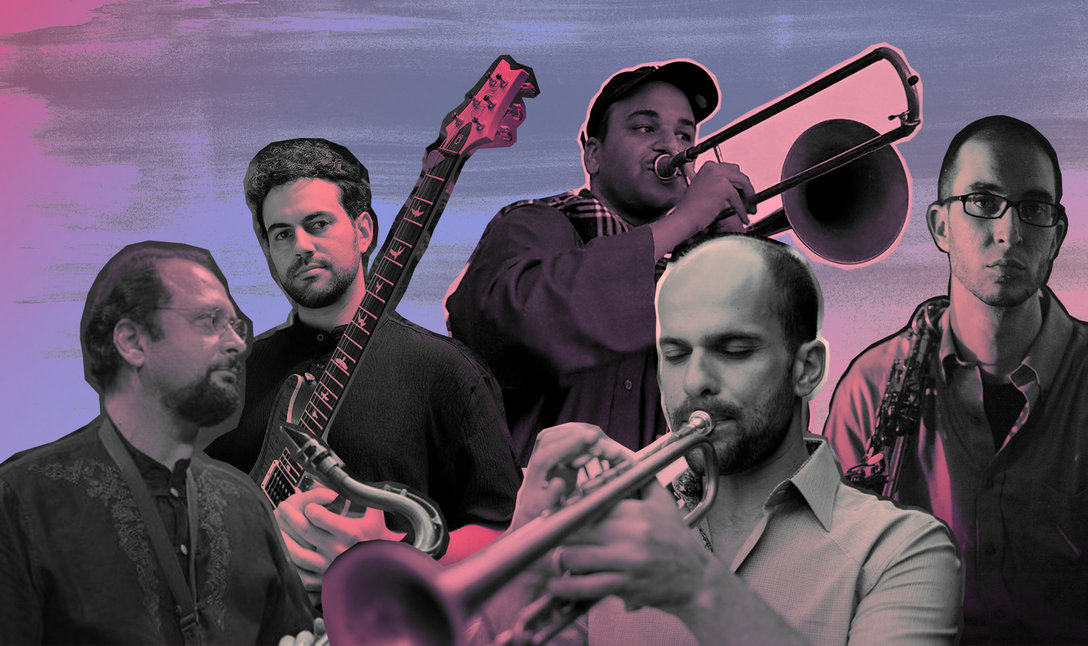
From the slurred blue notes of Louis Armstrong to the cutting sharpness of Jackie McLean, jazz has always been microtonal. But it’s only in recent decades that jazz composers have consciously engaged with alternative tuning systems to Western Equal Temperament, leading to “an efflorescence of microtonal music,” as drummer-composer Will Mason puts it. To ears raised on Western music, microtonal jazz can sound a little “off,” with soloists slipping between worlds while the harmonies warp and weave. The effects can be unsettling or woozily psychedelic, challenging conventional notions of beauty and correctness: all gravy to adventurous listeners. “It didn’t feel like a big leap for me to move from Eric Dolphy or Louis Armstrong to just intonation or spectralism,” Mason reflects. “Aesthetically, I’ve always found disorientation and near-familiarity appealing, and microtonality is excellent for fostering those feelings. But, again, so is just about any jazz solo that really stretches out.”
While European musicians such as Philipp Gerschlauer, Hayden Chisholm, Robin Hayward, Christian Lillinger, and Elias Stemeseder are exploring microtonality in their own fascinating ways, the center of action is in Brooklyn, home to a vibrant community of stylistically omnivorous composer-performers that gets bigger by the day. Among them is Vex Collection’s Mat Muntz, who regards this “collective investigation” of microtonality as the next frontier of experimentation. “Ten years ago something similar was happening with rhythm, where you had all these records pushing the odd-meter envelope to the breaking point but not really getting outside of established modern jazz or 20th-century classical pitch language,” he says. “So it makes sense that we would get here eventually.”
On a practical level, both Mason and Muntz point out, it’s never been easier to use alternative tunings in DAWs and notation software, especially given the growing exchange between jazz and classical music tunings. Popular compositional tools include just intonation, a 12-note system where the intervals are tuned to whole tone ratios, and EDO, which divides the octave into mathematically equal steps. Spectralism, in which compositional decisions are derived from the mathematical analysis of sound spectra, has also found its way into jazz, as have tuning systems from Indian, Middle Eastern, and Southeast Asian traditions.
Microtonal jazz artists are rarely purists in their approach. As Muntz explains, “treating tuning as an essential compositional parameter, something to be messed with on the same level as harmony, rhythm or form is attractive because there are so many ways to do it. I’m inspired by my peers doing it, not because I want to make music that sounds like theirs, but because it opens up so many questions and possibilities for the sounds and ideas in my head. My sense is that a lot of other young-ish musicians feel this way too.”
As a young musician in post-war Brooklyn, Joe Maneri played Italian, Greek, Turkish, Syrian, Jewish, Polish, and Irish music alongside bebop and modern classical. All this led to an interest in microtonality, resulting in remarkable early works like Paniots Nine, a visionary 1963 session that went unreleased until 1998. In the 1980s, he published Preliminary Studies In The Virtual Pitch Continuum, codifying his version of 72 EDO. Encouraged by his son, the violinist Mat Maneri, the saxophonist and clarinetist enjoyed a second act in later life. Together, they released several brilliant albums, beginning with 1995’s Get Ready To Receive Yourself, where the saxophonist’s snaking microtonal lines, gruff multiphonics, and tender asides are beautifully complemented by his son’s highly inventive violin playing. Maneri, who died in 2009, believed that microtonality was the future. His legacy continues through his son and the artists below.
Released in 2009, Steve Lehman’s Travail, Transformation & Flow broke new ground in applying spectralism to jazz composition. “In the French spectral tradition, consonance is intended to be tied more directly to frequential relationships than intervallic ones. In that sense, [spectralism] and just intonation share something in common,” the saxophonist explains. “The big trick of French spectral music is that you can have both microtones integrated into harmonies in highly nuanced ways and chord changes. Very handy for someone like me who grew up on chord changes!” Travail... still sounds like the future, with the alien harmonies of the four-horn frontline offset by vibraphonist Chris Dingman’s oblique pulse and Tyshawn Sorey’s dynamic, metrically slippery drumming. Yet it’s still recognizably jazz, with Lehman and bandmates trading thrilling lines on “Rudreshm” and delivering an inspired cover of GZA’s hip-hop classic “Living In The World Today.”
In the early 1990s, saxophonist Hafez Modirzadeh devised chromodality, a system for integrating Persian tones with Western equal temperament. This evolved into a “post-chromodal” approach in which all kinds of intervals co-exist. “The former concept retains references on cultural structures, while post-chromodal attempts to go beyond the focus on such distinctions,” he explains. “It’s important to note that both practices still have their own merits, just different results.” On 2012’s luminous Post-Chromodal Out!, Modirzadeh and trumpeter Amir El-Saffar modulate pitch through alternate fingerings and embouchure, while Vijay Iyer plays a specially tuned piano. Over a supple jazz rhythm section, Filipino kulintang gongs and Persian santur take the music further out. “The ‘retunings’ are really just tunings that allow all pitch types to coexist in a harmonious way,” adds Modirzadeh. “This takes time and trust, determined by the intention of the individual within their own collective experience.”
Drawn to the “untamed” sound and untempered tunings of traditional instruments like the Korean oboe piri, Scottish Highland bagpipes, and the Croatian bagpipe primorski meh, The Vex Collection’s Mat Muntz and Vicente Hansen Atria set about combining them with their own invented instruments, including the micro-aulus, a woodwind instrument modeled on the Ancient Greek double pipe that can play 31 divisions of the octave. “[It allows] us to construct composite scales from different combinations of pipes,” explains Muntz. On their 2022 debut, the pair are joined by piri player gamin and piper Matthew Welch. “For me, a lot of the coolest microtonal moments on our first record were total accidents. The primorski meh has an utterly unique tuning system that really doesn’t fit into any boxes—European, Balkan, Middle Eastern. I think that unplaceable sound, which gamin’s piri slides into organically—as if these instruments were meant to play together—does a lot to bring the listener into this alternate dimension of The Vex Collection.”
As an Egyptian raised in the U..S, trombonist Zekkereya El-magharbel is engaged in a personal journey to reclaim their cultural heritage. “After years of being in cultural paralysis, I claim the sonic future that I am meant to,” they write. 2023’s 8 Quranic maqamat organized by size connects Quranic recitation with the seven-note Arabic maqamat system. These solo trombone pieces, they explain, “bear the foundations of the melodic science…to show the essential beauty.” The trombone is the perfect instrument for this record, explains El-magharbel, “not only for its ease with non-Western tuning and phrasing, but also because of its proximity to religious music in its European origin, sometimes referred to as ‘God’s Instrument.’ I find that it has an incredible timbral range that is so true to our own voices, very closely mirroring the vocal tradition maqam is typically passed down through.”
Resonance is key to Will Mason’s 2005 album Hemlocks, Peacocks. “I had access to an acoustically phenomenal chapel where we recorded the album,” he says. “While writing the music, I spent a lot of time improvising in that space using LaMonte Young’s brilliant tuning system from ‘The Well-Tuned Piano,’ which I augmented from 12 pitch classes to 24.” Opening track “Hemlocks,” as he explains, explores those intervals, using “the cavernous natural resonance of the chapel to blur the line between timbral shadings of a note and distinct trilled pitches.” The result is eerily beautiful chamber jazz, with deVon Russell Gray’s keyboards creating an ethereal backdrop for Anna Webber and Daniel Fisher-Lochhead’s saxophones, and Mason’s drums driving the music from stillness to clamor. “I’m less interested in exploring tuning systems for their own sake than creating spaces that will encourage performers to play and improvise in ways they might not otherwise,” Mason adds.
Shadows is the culmination of composer-guitarist Alec Goldfarb’s interest in speculative musical histories. “The music asks questions about imagined continuities, alternate histories, and unrealized encounters, about how traditions travel, change, and reshape one another, while remaining deeply rooted,” he says. By bringing jazz, new music, and Hindustani classical together with the traditions of Southeast Asia, Goldfarb creates what he calls “an internally coherent universe with its own sense of time, logic, and possibility.” Through his travels and studies in Southeast Asia, Goldfarb built relationships with musicians like the Javanese experimentalist Roni Driyastoto, whose scratchy rebab animates Shadows. “The album grew naturally out of those experiences,” he adds. Each piece inhabits a different tuning world, investigating Indonesian, Thai, and Vietnamese traditions through tunings associated with contemporary experimental music. Applying sitar and sarod techniques to electric guitar, Goldfarb weaves a golden thread through angular woodwind, shimmering gongs, and DoYeon Kim’s gayageum.
Saxophonist, flutist, and composer Anna Webber combines just intonation with equal temperament, giving her music a delightfully woozy quality at times, a bracing sharpness at others (hence the title of her brilliant 2023 album Shimmer Wince). Unseparate, the second album from her Big Band with Angela Morris, opens with “Just Intonation Etudes,” written in 2020. “I was imagining what it would feel like after [Covid-19], ‘What would be the most joyful thing to play when we’re in a room together?’” she explains. “It felt like some big resonant chords would feel pretty good. Once I had that concept, I was able to imagine the rest of the music.” That longing for connection gives the suite its emotional arc, from the jittery excitement of “Pulse” to the exploratory conversation of “Timbre.” The concluding “Metaphor” is a powerful expression of community, as a stately theme moves through passages of otherworldly harmony and free improvisation.
Raised in Chicago, trumpeter-composer Amir ElSaffar’s musical grounding was in Western classical music, jazz, and blues. In his 20s, he connected with the maqam tradition of his Iraqi heritage, traveling to Baghdad and London for intensive study with master musicians like Hamid al-Saadi. ElSaffar began incorporating traditional Arabic music into his jazz, releasing his debut album Two Rivers in 2007 and Radif Suite, a co-led project with Hafez Modirzadeh, in 2009. Since then, he’s released several outstanding albums, including 2017’s Rivers Of Sound, featuring his 17-piece transcultural orchestra of the same name. Last year’s Live at Pierre Boulez Saal introduces his new quartet, featuring Tomas Fujiwara on drums, Tania Giannouli on microtonal piano, and Ole Mathisen on tenor saxophone. Traditional Iraqi forms are deeply embedded in ElSaffar’s graceful, elegiac, and fiery compositions, brought to the fore on “Ghazalu” by way of sung Arabic verse.
The fantastical narrative of Partisan Ship, which depicts an odyssey to a utopian micronation, emerges from the “imaginary soundworld” of pianist-composer Phillip Golub. Conceiving the album as a suite for the recording studio unlocked many possibilities, he explains: “I could do away with all notions of the album having to sound like a real ensemble of people playing together in a room. I could have layers of instruments, waves of electronic sound. I could lean into all kinds of impracticalities, notably, writing extremely hard microtones, hard rhythms, and hard passages to balance as an ensemble.” Golub plays a standard MIDI keyboard in different tunings, a self-described “uncanny valley” between acoustic and synthetic sound that’s perfectly suited to the music. For all its complexity, Partisan Ship is an exhilarating listen, with the crew (which includes Anna Webber, Amir ElSaffar, and Elias Stemeseder) conjuring moments of swashbuckling drama, stirring solidarity, and otherworldly beauty.
source
Thanks for visiting our page. Don’t forget to go to our home page for more microtonal and indie music news.