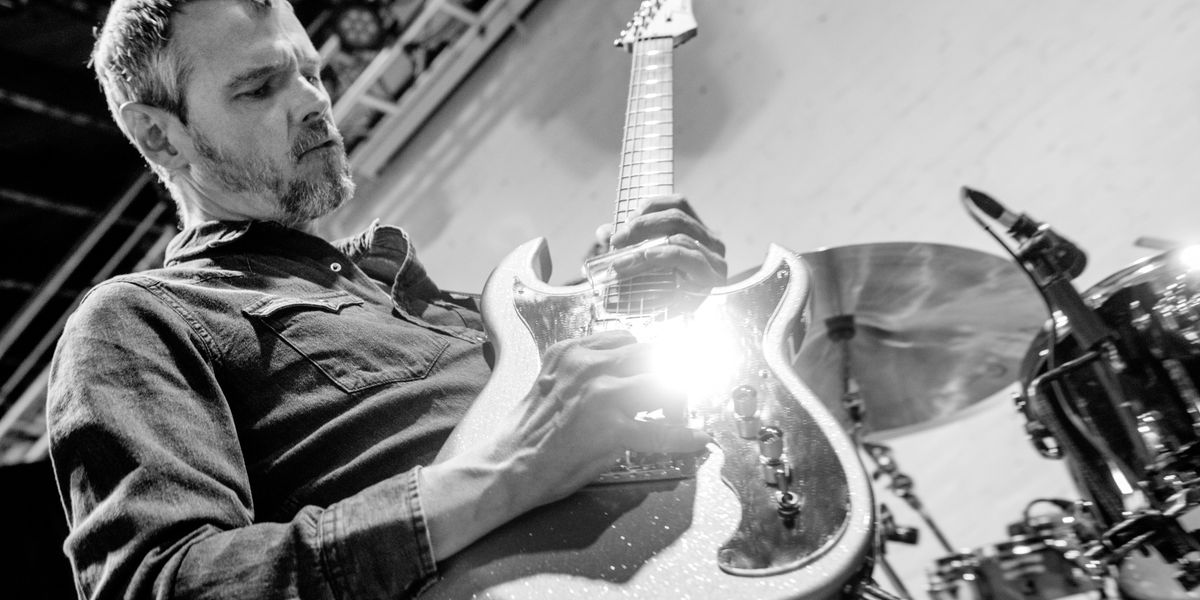
Big and small, loud and louder, here are the noise makers we’ll take to our graves.
Luther Dickinson is this month’s guest guitarist. His band, North Mississippi All Stars, have a new album, Still Shakin’, that’s just been released.
Question: What’s your No. 1 amp and why do you play it?
GUEST PICKER Luther Dickinson
Luther’s current guitar amps are his signature Category 5s.
A: My main amp on the road is my signature Category 5 LD100 (or LD50 in a small room). Don Ritter and Barry Dickson of Category 5 and I designed this amp similar to a 100-watt Marshall plexi, but with nice subtle spring reverb and a groovy tremolo that goes from very slow to very fast with a foot pedal controlling the speed.
Obsession: Live Prince concert footage does not count because that’s constant, but I’m thrilled by Tolgahan Çoğulu and his microtonal guitar YouTube page! As a slide player I’m familiar, even intimate, with some of the microtones they utilize with these amazing guitars with movable modular frets, and thus I love his music, approach, and this scene (including King Gizzard and the Lizard Wizard).
Reader Steve Rempis with a high-flying bird!
A: Having recently embraced doom metal in a big way, I started on a quest to find the perfect amp for getting a distinctive tone and taking fuzz pedals. After trying all the usual suspects, I stumbled upon a circa 1972 (just like me) Kustom Hustler 4×10 combo. This amp gives me what I consider to be my ideal doom tone, especially when the bright switch is engaged (contrary to conventional wisdom). I pair the Kustom with a Roland JC-40, which handles all my time-based effects. My rig looks and sounds unique, and most definitely dooms!
Three fuzzes, no waiting!
Obsession: My current obsession is parallel fuzzes. When looking for my perfect fuzz sound, I found that I had three pedals (a Pro Co RAT 2, a Rowin Frenzy, and a Keeley Suns) that didn’t get me what I wanted in isolation, but each did great things as part of my tone spectrum. The obvious solution? Run all three! A little internet research led me to the Electro-Harmonix Tri Parallel Mixer pedal, which allowed me to run all three pedals together as separate signals which were then combined at the output. No “stacking” required. I now have a “best of all worlds” fuzz sound that brings a big grin to my face every time I plug in.
Our gear editor’s first amp!
A: My 1964 Fender Tremolux is my first amp and it’s certainly the last one I would ever sell. For my purposes, the Tremolux, with its 30 watts and tube rectifier, deftly splits the difference between a tweed Fender’s squish and growl and a black panel’s clarity and immediacy—a nice lane for a lad that counts circa-’69 Crazy Horse, early-’60s South Bay surf, and Mod-era Pete Townshend as tone ideals. With a Fender Reverb unit and an Echoplex out front, it is pure joy.
Obsession: Making space in mono mixes. It’s a great workout for the ears, a cure for option fatigue, and reinforces and encourages smart arrangement decisions. But as an individual that marvels at the potency, punch, and sometimes spooky ambience heard in mono records, it’s fun chasing the magic that lurks in those slabs of wax.
Associate editor Luke Ottenhof loves his Dr. Z.
A: My Dr. Z Maz 18 Junior 2×10 combo has been my dream machine for about 11 years now. It’s a Mark I model, with reverb. A few months back, it wasn’t keeping up with my band at a show, so I started looking around for a used amp in the 50-watt range. I went through a few heads and cabinets only to end up back at my Z, which I paired with a Fryette PS-2 to raise its wattage to 50. Maybe 11 years of Z has just cemented my amp’s frequency range in my brain, but whatever the case, it just feels like home.
The Maz 18
Obsession: Finding the perfect balance between chime, depth, and aggression. I favor single-coil tones that have a lot of pluck and definition, but striking the right harmony with top-end clarity and thick, characterful distortion is tricky. Blue Colander’s Crooked Axis, a massively expanded take on the Colorsound Power Boost, has been getting me there the past few months. But I have started to wonder: Can I depend on my ears to dial in the sound I want, or have I lost enough high frequencies in my hearing that I’m not a reliable tone sculptor? Overthinkers anonymous, unite.
Blue Colander’s Crooked Axis, a massively expanded take on the Colorsound Power Boost,
Question: What was the most exciting change in your guitar playing this year?
Photo by Marianka Campisi
A: My guitar playing is pretty constantly shifting, but in the last few years, I feel like I’ve really “found it.” And I’d attribute that to a personal change, honestly. I’m no longer afraid to show what I’ve got. I grew up playing, but I was a slightly “embarrassed” guitar player, if that makes sense? I loved indie rock and I loved singer-songwriters, and at that point in my life, I felt like the guitar solo was maybe a gratuitous move, and so for years, I hid my playing abilities. Not only that, but because I was so self-conscious, every time I stepped up for a rare solo, I had so much going on in my head that I never felt free.
I’m in my thirties now, and I would never say I don’t care anymore—I’ll always care about what music means, who it’s for, what it says, what each note indicates to the listener. But I am who I am, and I think that people are their best musical selves when they’re singing and playing at the top of their ability. And that’s what I’m gonna do. You’ll be hearing a lot more guitar on my records from here on out. I’m a proud guitar player, no way around it.
Obsession: Current obsession is a 1973 Tele Deluxe that I just bought!
A: This last year I’ve noticed that I’m not using a pick very often, and I’m really enjoying the direct contact of fingers and fingernails on strings. Also, I’m using very few effects with no reverb or delay, and that feels like I’m closer to the instrument’s vibrations. So I’m just down to a Rothwell Switchblade distortion into my ZT Lunchbox and an Emma TransMORGrifier compressor for clean stuff—and both together for neighbor-friendly feedback.
Also, after 45 years I’ve grown dissatisfied with humbuckers and want single-coil clarity and hi-fi detail but without the hum and buzz. So I’ve been researching noiseless Strat pickups until my eyes got bleary. There’s some Bill Lawrence Wilde pickups on their way to go in my ’80s Squier Strat.
Obsession: Current musical obsessions include Black Sabbath’s Master of Reality. I’m left-handed, so Tony Iommi will always be a hero for me. I’ve also been revisiting Derek Bailey’s solo recordings like Lot ’74. He completely changed the way I think about music when I saw him play in 1986. Free improvisation is the most rewarding kind of music making I know. Ornette Coleman’s Love Call has also been heating up my speakers this week.
Photo by Carla Fredericks
A: Sweep picking. Not a new concept for someone who grew up listening to metal in the ’80s and ’90s, but as much as I was into fast, technical playing, something about sweeping always left me cold. Too video-game sounding, before that was actually a thing guitarists were trying to sound like! But now my son plays, and one of the solos he tackled this year was Marty Friedman’s daunting leads in Megadeth’s “Tornado of Souls.” Like everything else, we played it together. So, more than 30 years after I was hunkering down in my bedroom with the Hal Leonard official Rust in Peace tab book, I was finally sweeping up and down the frets.
Obsession: Cobra Kai, for maybe a third (fourth? fifth?) go-round. It just hits the perfect note of self-aware nostalgia, and the guys behind the score—Zach Robinson and Leo Birenberg—are two of the most imaginative guitar-based composers around. What’s more, they tapped ace ringers like Tim Henson, Andrew Synowiec, Myrone, and even Tosin Abasi to lend a hand, making it essential viewing—and listening—for guitar nerds.
A: Freedom. After recently retiring as editorial director of PG, it seems I’ve been pushing the envelope more—in the disparate directions of tradition and outrage, and feeling more comfortable and relaxed with a guitar in my paws. I think the title made me self-conscious about my playing, which is never a good thing. I’m excited about what happens next!
Obsession: The thrilling, evolutionary period of jazz from the mid 1940s to 1975, thanks to James Kaplan’s extraordinary book 3 Shades of Blue: Miles Davis, John Coltrane, Bill Evans, and the Lost Empire of Cool. It’s reconnected me to this wonderful, diverse, and sometimes extreme, often beautiful music I’ve loved so long, but had lost contact with.
Greg Koch performing live.
Question: What albums should every guitarist listen to and why?
Billy Ward of Man/Woman/Chainsaw
Question: What’s the most rewarding aspect of playing music for you? Photo by Ella Margolin
Mei’s latest album, Kabutomushi.
A: The picking style I’ve practiced the most is alternate picking, but the picking style I usually end up using is economy picking. Alternate feels like a dependable way to achieve evenness when practicing scales and arpeggios, but when really playing, it doesn’t make sense to articulate every note in that way, and obviously it’s not always the fastest.
Obsession: My current music-related obsession is my guitar, my PRS McCarty 594 Hollowbody II. I think it will always be an obsession for me. It’s so comfortable and light, has a lovely, warm, dynamic tone, and helps me play faster and cleaner. This guitar feels like my best friend and soulmate.
Photo by Ryan Fannin
A: For decades, the Eric Johnson-style “hybrid picking” with a Jazz III for “pianistic” voicings. Great for electric, though not so much acoustic. I’ve been recently learning to use a flatpick, à la Brian Sutton, by driving the pick “into” the string at an angle—which makes me think of Pat Metheny and George Benson, without irony.
Obsession: I’m still focused on understanding the concepts of jazz, neo-classical, and beyond, though I’m also becoming obsessed with George Van Eps’ 7-string playing, flatpicking, hip-hop beats, the Hybrid Guitars Universal 6 guitar, and the secret life of the banjo.
A: Decades ago, under the sway of Mississippi blues artists R.L. Burnside, Junior Kimbrough, and Jessie Mae Hemphill, I switched from plectrum to fingerstyle, developing my own non-traditional approach. It’s technically wrong, but watching R.L., in particular, freestyle, I learned there is no such thing as wrong if it works.
Obsession: Busting out of my songwriting patterns. With my band Coyote Motel, and earlier groups, I’ve always encouraged my talented bandmates to play what they want in context, but brought in complete, mapped-out songs. Now, I’m bringing in sketches and we’re jamming and hammering out the arrangements and melodies together. It takes more time, but feels rewarding and fun, and is opening new territory for me.
A: I have always been drawn to fingerpicking on acoustic guitar, starting with classical music and prog-rock pieces (“Mood for a Day” by Steve Howe), and moving on to ’70s baroque-folk styles, basic Travis picking, and songs like “Back to the Old House” by the Smiths. I love the intricacy of those styles, and the challenge of learning to play different rhythms across different fingers at the same time. This is definitely influenced by my classical training on piano, which came before guitar.
Obsession: Writing and producing my fifth and sixth albums. My fifth album, Creature Comforts, was recorded over the past couple months, and features a bunch of songs I wrote in 2022 that I had previously sworn to never record or release. Turns out, upon revisiting, they’re not half bad! While that one’s being wrapped, I’m trying to get music written for my sixth, for which I already have four songs done. And yes, this is a flex. 💪😎
source
Thanks for visiting our page. Don’t forget to go to our home page for more microtonal and indie music news.