
This site, like many others, uses small files called cookies to ensure that we give you the best experience on our website. If you continue without changing your settings, we’ll assume that you are happy to receive all cookies on this website (Cookie Policy). However, if you would like to, you can change your cookie settings at any time.
2024-10-07T09:16:00+01:00
Composer Anselm McDonnell writes about curating a concert for multiple violins that pushes the boundaries of traditional tuning and intonation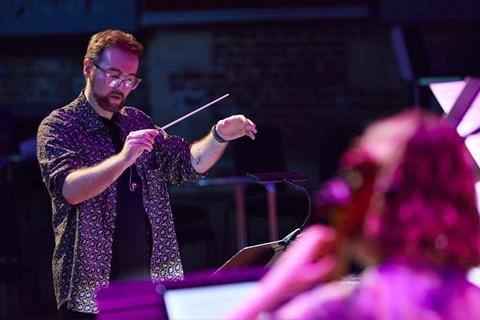
Composer Anselm McDonnell at LSO St Luke’s. Photo Kevin Leighton
Discover more Featured Stories like this in The Strad Playing Hub
The Expanded Violin is a programme focused on modern trends in violin writing. It explores repertoire for violin and electronics, pieces for multiple violins, and investigates minute intervals through microtonality. The concert is my second curated event with the London Symphony Orchestra through the Jerwood Composer+ Scheme, and takes place at LSO St Luke’s at 7pm on 12 October 2024.
Out of current trends in contemporary string writing, the one I find most fascinating, and that is fast becoming widespread, is microtonality. Questions of intonation, tuning and minute detail have always been a part of string pedagogy, but not necessarily of concern for composers, but in microtonality these questions become prominent parts of the creative process. Microtonality is often used as an umbrella term for music that uses intervals smaller than a semitone or employs a tuning system other than 12-tone equal temperament, which is the predominant tuning system used in Western genres, including classical music.
Bowed stringed instruments are well suited to various tuning systems because they are not locked into a set tuning by frets, and the aural precision of tuning to other players in an orchestra/string section setting means performers are already trained to pay attention to miniscule details of intonation. My own two pieces on the programme explore the rich harmonies and sonorities available to the violin through microtonality.
Rusted Sugar, commissioned by Larissa O’Grady, is written in 24 equal divisions of the octave (24 EDO), a system that adds notes between each semitone, resulting in intervals called quarter tones. For a string player this requires precision, but if you can play a semitone, it is not too far a step to find and physically learn the location of the note in between, especially at the low end of the fingerboard where notes are further apart.
Chords tuned in just intonation noticeably drift further away from equal temperament as more notes are added. These chords have a different quality to their equal-temperament cousins: some become very smooth, others agitated and fuzzy
My second piece, Genesis Cradle, commissioned by the LSO for Mira Benjamin, uses a tuning system called just intonation, as do the two pieces by Chiyoko Szlavnics. Unlike equal temperament, intervals in this system are not always the same size but are tuned to the distances that arise naturally in the harmonic series. For example, in just intonation, the first major third is a little lower than the one you’d hear on the piano. While this may not sound like a huge difference, chords tuned in just intonation noticeably drift further away from equal temperament as more notes are added. These chords have a different quality to their equal-temperament cousins: some become very smooth, others agitated and fuzzy.
For just intonation, the process of tuning each note requires detailed listening. With practice, a performer can learn to recognise the beating patterns and quality of different intervals, which are indicated in the score by fractions. While this may initially appear quite daunting, it is surprising how quickly you can adjust to hearing the difference. After working on Genesis Cradle for about a month, my equally tempered piano started sounding very unusual to me! 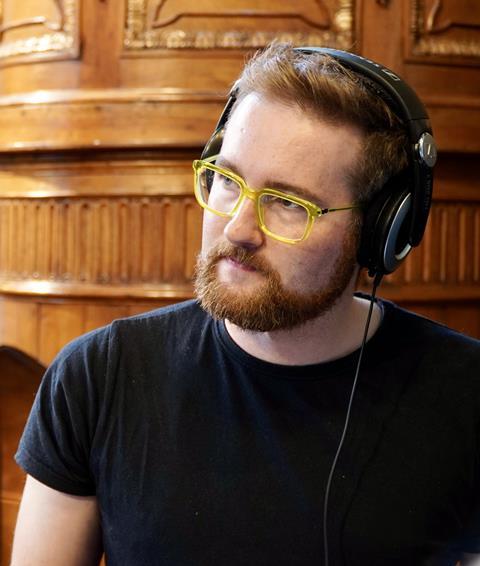
Anselm McDonnell Photo Cormac O’Kane
Despite the widespread use of just intonation in music of other cultures, the fact that most synthesised electronic instruments (including orchestral sample libraries) are designed for the creation of equal temperament music means other tuning systems can feel unfamiliar to Western ears. Film and game music, along with most popular electronic genres, are created with these tools. The most difficult issue I faced in composing was not using microtones on the violin but getting an electronic synthesiser to use these systems. This lack of familiarity often means that microtonal music in classical contexts leans towards a meditative aesthetic that encourages listeners to rediscover and hear the beauty of microtonal harmonies.
When choosing repertoire for the concert, I selected pieces that foster an atmosphere of unhurried time and space, either for the contemplation of emotional responses (such as the two In Memoriam pieces by Saariaho and Aho), or submersion in a world of slowly changing harmonies (Chadburn’s De La Salle). The concert atmosphere will be a space for deep listening, for audiences to become absorbed in the rich sound worlds of each piece.
The rehearsal process for each composition on the programme will be quite different, as they have their own unique challenges. For the three pieces using electronics, performers need to follow a timer so they can sync with the backing track, as well as listening closely to the synthesised harmonies they will hear back on monitors. In the two duos by Szlavnics, players instead must tune to each other, and these pieces explore a limited and precise harmonic space full of small, detailed movements and glissandi. Violin quartets such as Wilson’s Primavera require a different kind of listening, as each player moves rapidly through the texture in a way that is not as pronounced in string quartet playing. The harmony and rhythmic writing is very close-knit and requires intense concentration and responsiveness to perform this light and agile music.
The Expanded Violin, curated by Anselm McDonnell, takes place at 7pm on 12 October 2024 at LSO St Luke’s, London, UK.
Read: Extended and splendid: 4 techniques for bowed strings to get the creative cogs turning
Read: In search of sounds: contemporary violin techniques with Sarah Saviet
Discover more Featured Stories like this in The Strad Playing Hub
The number one source for playing and teaching books, guides, CDs, calendars and back issues of the magazine.
In The Best of Technique you’ll discover the top playing tips of the world’s leading string players and teachers. It’s packed full of exercises for students, plus examples from the standard repertoire to show you how to integrate the technique into your playing.
The Strad’s Masterclass series brings together the finest string players with some of the greatest string works ever written. Always one of our most popular sections, Masterclass has been an invaluable aid to aspiring soloists, chamber musicians and string teachers since the 1990s.
The Canada Council of the Arts’ Musical Instrument Bank is 40 years old in 2025. This year’s calendar celebrates some its treasures, including four instruments by Antonio Stradivari and priceless works by Montagnana, Gagliano, Pressenda and David Tecchler.
An exclusive range of instrument making posters, books, calendars and information products published by and directly for sale from The Strad.
The Strad’s exclusive instrument posters, most with actual-size photos depicting every nuance of the instrument. Our posters are used by luthiers across the world as models for their own instruments, thanks to the detailed outlines and measurements on the back.
The number one source for a range of books covering making and stringed instruments with commentaries from today’s top instrument experts.
The Strad Calendar 2026 showcases twelve of the finest instruments in the collection of Canimex, one of Canada’s leading arts supporters. They include masterpieces by Stradivari, Guarneri ‘del Gesù’, Guadagnini and Gagliano.
The number one source for playing and teaching books, guides, CDs, calendars and back issues of the magazine.
In The Best of Technique you’ll discover the top playing tips of the world’s leading string players and teachers. It’s packed full of exercises for students, plus examples from the standard repertoire to show you how to integrate the technique into your playing.
In the second volume of The Strad’s Masterclass series, soloists including James Ehnes, Jennifer Koh, Philippe Graffin, Daniel Hope and Arabella Steinbacher give their thoughts on some of the greatest works in the string repertoire. Each has annotated the sheet music with their own bowings, fingerings and comments.
The Strad Calendar 2026 showcases twelve of the finest instruments in the collection of Canimex, one of Canada’s leading arts supporters. They include masterpieces by Stradivari, Guarneri ‘del Gesù’, Guadagnini and Gagliano.
2024-10-17T23:55:00Z
Thomas May attends their concert of Bach and music by Meyer himself at the University of Washington’s Meany Center for the Arts in Seattle on 16 October 2024
2024-10-16T08:39:00Z
The composer explains the background for her work Three Tributes, ahead of its UK premiere by the Dudok Quartet Amsterdam later this week
2024-10-11T08:47:00Z
Bruce Hodges takes a trip down to Mary Flagler Cary Hall in New York’s Dimenna Center on 13 August 2024 for the performance of Jonah Haven, Katherine Balch and Igor Santos
2026-08-25T09:05:00Z
Davina Shum reports from four concerts at the 2026 Edinburgh International Festival, where a diverse range of repertoire from Bach to Ortiz satiated the musical appetites of the ever-hungry festival attendees
2026-08-24T08:41:00Z
Composer Deborah Pritchard explores the artistic and spiritual inspirations behind Nightingale, her new violin concerto for Harriet Mackenzie, inspired by the paintings of Maggi Hambling
2026-08-21T08:42:00Z
Daniel Rowland, the artistic director of the Stift International Music Festival, reflects on the music and his connection with the celebrated composer, as the festival prepares for its 2026 edition
Site powered by Webvision Cloud
source
Thanks for visiting our page. Don’t forget to go to our home page for more microtonal and indie music news.