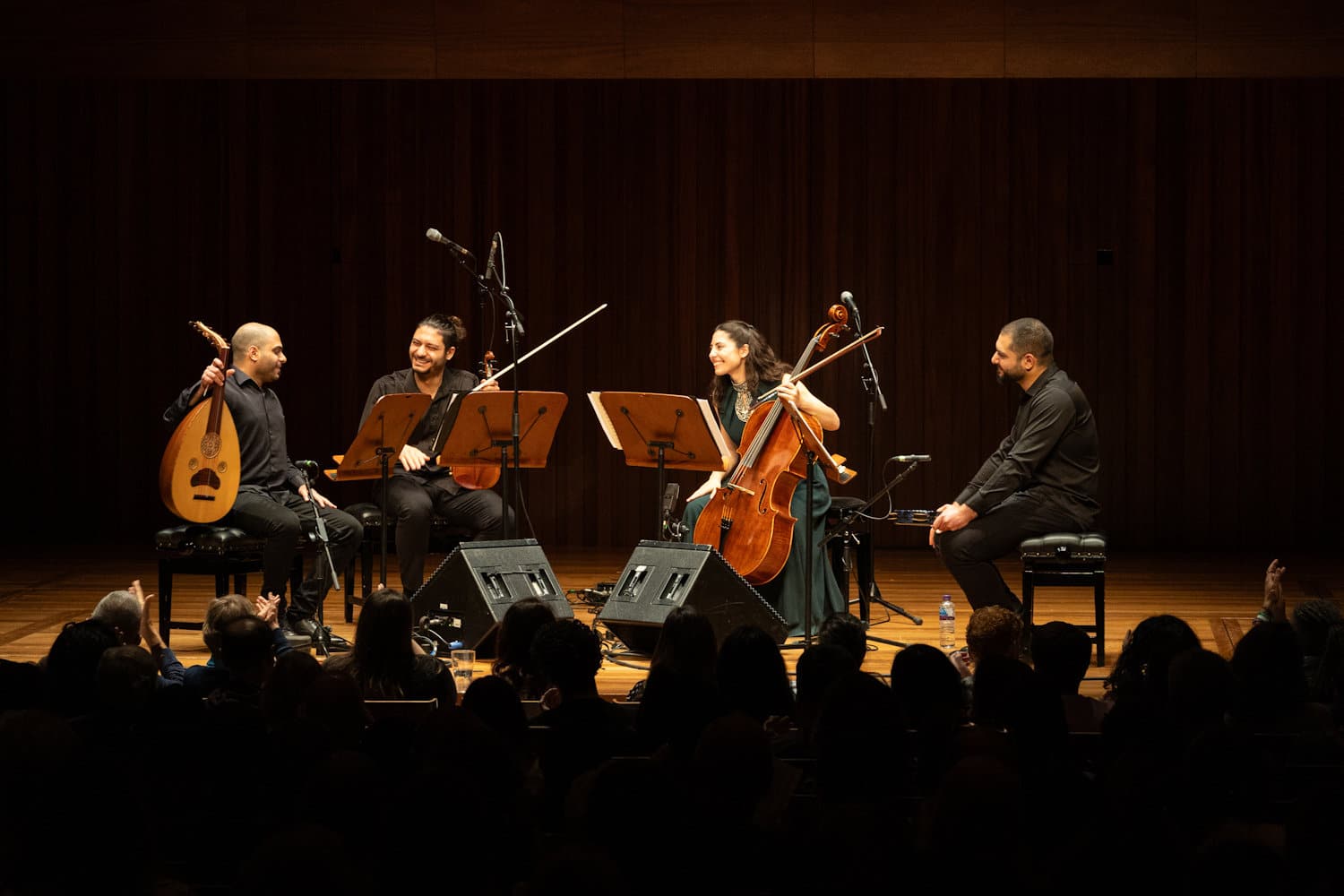
String quartets that consist entirely of family members are not as rare as you’d think – indeed, the kind of synergy that feeds the excellence of chamber music can often be more easily acquired in a family group that has always made music together. Galilee Quartet is a Palestinian ensemble made up of four Saad siblings (Mostafa, Gandhi, Omar, Tibah) from the village of Maghar in Galilee.
Their music is a fusion of Western classical and Arabic traditions, most obviously exemplified by their dual roles within their performances. Gandhi and Tibah are equally adept playing (respectively) violin and cello as they are with delivering the ornamented vocal lines of Arabic tradition; Omar is at home playing either viola or percussion (in this instance, a tambourine), while Mostafa exhibits brilliance on both violin and oud.
Sunday evening’s concert at Milton Court began with Anton Webern’s delicious late-Romantic Langsamer Satz in its original version for string quartet. The playing here was perfectly blended, the tone mellow, as the four leant into the work’s chromatic expressions. The odd entry was a little tentative, but the four soon settled into an assured account, and the later passage of cello solo with light accompaniment from the other three strings was performed with elegance and assurance.
For most of the rest of the first half, the group kept their ‘Western’ instruments, but presented us a with a series of pieces (mostly composed by Mostafa) that were clever and inventive alloys of 19th century Romanticism and the signature Maqam-based tropes of music of the Middle East.
Tour in Galilee was composed by Mostafa as a gift for Omar on his release from prison after his refusing to serve in the Israeli army. It began (seemingly at odds with this deeply harrowing subject) with a sprightly theme that put one in mind of a Vaughan Williams folksong arrangement. Gradually, though, arabesques and microtonal ornamentation weaved their way into the material, and, after a rapid, rhythmic section, a virtuosic Maqam-based passage for Mostafa’s solo violin (perhaps, here, substituting for a rabab) emerged, after which the piece reverted once again to a Western tonality.
The two following pieces, (Mostafa’s Conflict and Esordio) followed a similar pattern of fusion of styles, the ensemble demonstrating their excellent co-ordination and familiarity with the music, from the adroit passing of motifs, quietly busy figures and subsequent dazzling whirl of a dance in Conflict to the precision of Esordio’s initial pizzicato tiptoeing, through the increasing dynamic of exchanges of arpeggios, to the frenetic flurry of notes underpinned by solid ostinato bow strokes from the viola.
“…the ensemble demonstrating their excellent co-ordination and familiarity with the music, from the adroit passing of motifs, quietly busy figures and subsequent dazzling whirl of a dance…”
In his brand new piece Zakhrufaa’, Gandhi also demonstrated a deal of virtuosic violin playing, and here, we started with a Western-instrument version of a taqism – a kind of improvised solo section – this example being a fast, rhythmic figure, rather than the more usual slower, ‘cadenza’ style. He then lent his voice to the subsequent bustle of a rhythmic dance. More melismatic vocal ability was to follow in Fairouz’ Yallah tnam Rima, a traditional lullaby of the Arabic world, here sung hauntingly by Tibah, to minimal drone and pizzicato accompaniment from the other instruments, who eventually left Tibah alone the stage, finishing the song in a quietly hair-raising dramatic gesture.
After the interval the music became more firmly rooted in Arabic traditions, as Omar took up his tambourine, Mostafa replaced his violin with an oud, and Gandhi and Tibah alternated singing with violin or cello. Now augmented with microphones and amplification, the music took on a more rhythmic character. More traditional tagisms abounded (indeed, the whole of Mostafa’s Ala Kefha was an exercise in improvisation), long, sung (or played) melismatic lines featured heavily, and each piece was marked by artfully co-ordinated shifts in tempo.
Of the selection offered, three stood out. 1930s Syrian singer Asmahan’s medley of two love songs, Ya Habibi Ta’ala and Emta Hata’raf, engagingly sung by Tibah; Gandhi’s Sama’I Eitab (converted from an original for saxophone), whose questioning nature was ingeniously portrayed through recurring cadential summaries, stops and starts, and solo perorations from violin and oud; and Mostafa’s lengthy Sunrise, a complex and beautiful series of changes in speed, complexity and mood that allowed Mostafa to demonstrate his artistry with the oud, and which really should be expanded and adapted into a concerto for the instrument.
• A BBC interview with the quartet about their lives and music can be found at bbc.co.uk
musicOMH uses cookies to understand how the site is used and to serve advertising. You can accept all cookies, deny non-essential ones, or manage your preferences by category.
source
Thanks for visiting our page. Don’t forget to go to our home page for more microtonal and indie music news.