Or, growing old with a Guyatone
Last weekend I got together with a bunch of high school friends. I hadn’t seen some of them in over 30 years, but conversation was easy and our shared memories and “exploits” led to some good laughs. We all sat around the fire pit with wild eyes! I suppose from the outside most of us are simple vestiges of what we once were, but on the whole we were all talking about current passions and endeavors. Eventually we got around to music, and then guitars.
When we began playing instruments, particularly guitars, we all started out on cheaper imports. I mean, after all, we were the sons of steel and quarry workers. But it was all good because we were content with any approximation of a “cool” guitar. Case in point: the Emperador!
Of course we all would have been happy with a real Gibson, but to us a guitar like this was almost as cool. Towards the tail end of the 1960s, imported “copy” guitars were becoming more popular and caused quite the stir in guitar-land with the threat of legal action towards spec-by-spec clone guitars. It was difficult to regulate, and many Japanese guitar makers changed minor aspects to keep U.S. guitar manufacturers at bay.
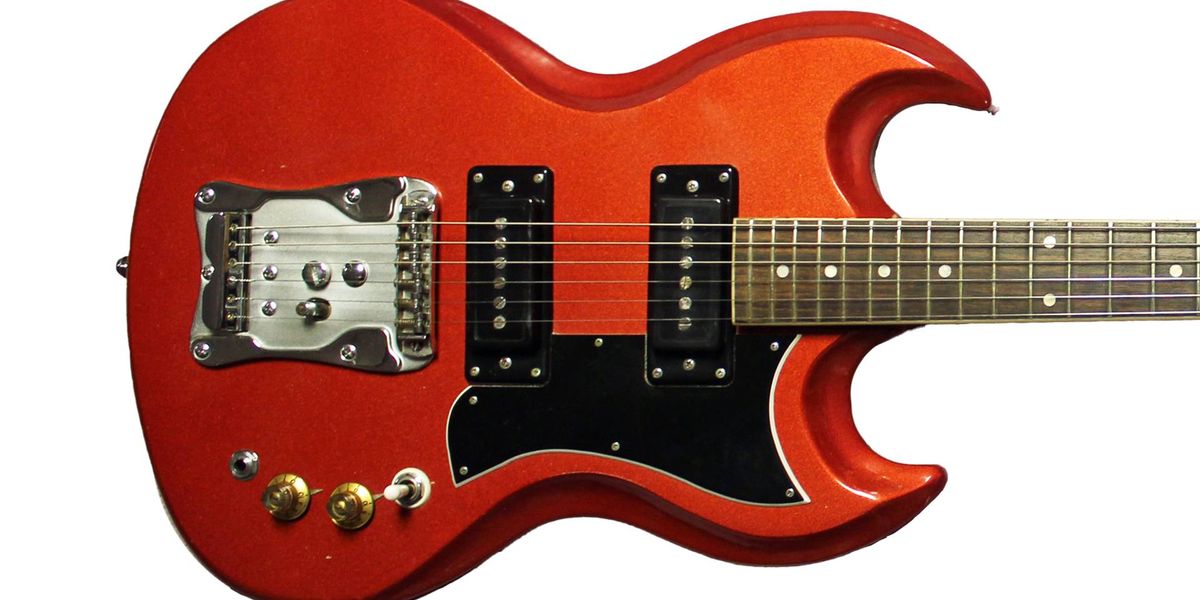
This guitar offers that classic SG shape but with some Japanese flair. The more extreme cutaways and body sculpting combined with a tremolo and different pickups make it a more adventurous example than the typical faded cherry SG. The Emperador finish is bright and in your face.
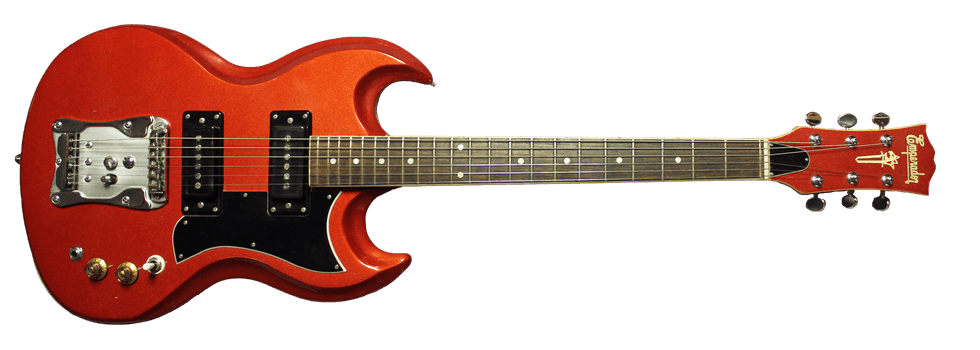
This Japan-built Emperador was stitched together from Guyatone components.
You might have noticed this guitar has Guyatone components, like that tailpiece/tremolo. That was a Guyatone exclusive, found on the famous Sharp 5 guitars and a few others. And those pickups are also Guyatones. In fact, those were specially designed alnico units (which sound really nice) from around 1967. Even the electronics were Guyatone designs. I’ve seen examples of this same instrument in a vibrant blue color as well. So, is this a Guyatone guitar? Well, yes and no.
The Emperador brand name was apparently used by a Canadian importer, so if you live up north you may have seen this name before. The backstory of Guyatone and these Guyatone-adjacent guitars goes like this: The owner/founder of Guyatone was Mitsuo Matsuki, and believe me when I say this guy was a scrapper. He had been in the musical-instrument game since the late ’40s, primarily making amps and electronics. The company really dove into electric instruments in the late ’50s and Mitsuo was building new factories to keep up with growing demand. Alas, as the 1960s wore on, that demand faded and Guyatone went bankrupt in 1969. Now, just because a Japanese company goes bankrupt does not mean the factory gets shuttered. All those parts and partially made instruments will be resurrected in some way, and that’s what happened all the time in the late ’60s and early ’70s.
For instance, some factories only made the wood portions of guitars. And other factories only made the electronics and/or hardware like tremolo units, tuners, etc. During the ’50s and ’60s in Japan, many guitar factories simply partnered with others to make whole guitars. During Guyatone’s run, there were some years when they made guitar bodies and necks, and other times where the work was farmed out. But Guyatone consistently made electronics like pickups, and they were some of the best to come out of Japan.
Basically, what we have here is like a “combo” guitar that incorporated Guyatone components during a time when Guyatone was struggling. Matsuki came out in the ’70s by rebuilding his company from the ground up, and Guyatone guitars did rather well in the ’70s. But this guitar was made during that strange window of time where Guyatone was at the lowest point in the company’s history.
Sitting around the fire pit with my friends that night was a nice ride around old memories, like wisps of gray hair. We may have achy joints, but we’ve still got eyes as vibrant as this Emperador’s finish, glowing in the fading flame of youth.
When we began playing instruments, particularly guitars, we all started out on cheaper imports. I mean, after all, we were the sons of steel and quarry workers. But it was all good because we were content with any approximation of a “cool” guitar. Case in point: the Emperador!
Of course we all would have been happy with a real Gibson, but to us a guitar like this was almost as cool. Towards the tail end of the 1960s, imported “copy” guitars were becoming more popular and caused quite the stir in guitar-land with the threat of legal action towards spec-by-spec clone guitars. It was difficult to regulate, and many Japanese guitar makers changed minor aspects to keep U.S. guitar manufacturers at bay.
This guitar offers that classic SG shape but with some Japanese flair. The more extreme cutaways and body sculpting combined with a tremolo and different pickups make it a more adventurous example than the typical faded cherry SG. The Emperador finish is bright and in your face.
This Japan-built Emperador was stitched together from Guyatone components.
You might have noticed this guitar has Guyatone components, like that tailpiece/tremolo. That was a Guyatone exclusive, found on the famous Sharp 5 guitars and a few others. And those pickups are also Guyatones. In fact, those were specially designed alnico units (which sound really nice) from around 1967. Even the electronics were Guyatone designs. I’ve seen examples of this same instrument in a vibrant blue color as well. So, is this a Guyatone guitar? Well, yes and no.
The Emperador brand name was apparently used by a Canadian importer, so if you live up north you may have seen this name before. The backstory of Guyatone and these Guyatone-adjacent guitars goes like this: The owner/founder of Guyatone was Mitsuo Matsuki, and believe me when I say this guy was a scrapper. He had been in the musical-instrument game since the late ’40s, primarily making amps and electronics. The company really dove into electric instruments in the late ’50s and Mitsuo was building new factories to keep up with growing demand. Alas, as the 1960s wore on, that demand faded and Guyatone went bankrupt in 1969. Now, just because a Japanese company goes bankrupt does not mean the factory gets shuttered. All those parts and partially made instruments will be resurrected in some way, and that’s what happened all the time in the late ’60s and early ’70s.
For instance, some factories only made the wood portions of guitars. And other factories only made the electronics and/or hardware like tremolo units, tuners, etc. During the ’50s and ’60s in Japan, many guitar factories simply partnered with others to make whole guitars. During Guyatone’s run, there were some years when they made guitar bodies and necks, and other times where the work was farmed out. But Guyatone consistently made electronics like pickups, and they were some of the best to come out of Japan.
Basically, what we have here is like a “combo” guitar that incorporated Guyatone components during a time when Guyatone was struggling. Matsuki came out in the ’70s by rebuilding his company from the ground up, and Guyatone guitars did rather well in the ’70s. But this guitar was made during that strange window of time where Guyatone was at the lowest point in the company’s history.
Sitting around the fire pit with my friends that night was a nice ride around old memories, like wisps of gray hair. We may have achy joints, but we’ve still got eyes as vibrant as this Emperador’s finish, glowing in the fading flame of youth.
Last weekend I got together with a bunch of high school friends. I hadn’t seen some of them in over 30 years, but conversation was easy and our shared memories and “exploits” led to some good laughs. We all sat around the fire pit with wild eyes! I suppose from the outside most of us are simple vestiges of what we once were, but on the whole we were all talking about current passions and endeavors. Eventually we got around to music, and then guitars.
When we began playing instruments, particularly guitars, we all started out on cheaper imports. I mean, after all, we were the sons of steel and quarry workers. But it was all good because we were content with any approximation of a “cool” guitar. Case in point: the Emperador!
Of course we all would have been happy with a real Gibson, but to us a guitar like this was almost as cool. Towards the tail end of the 1960s, imported “copy” guitars were becoming more popular and caused quite the stir in guitar-land with the threat of legal action towards spec-by-spec clone guitars. It was difficult to regulate, and many Japanese guitar makers changed minor aspects to keep U.S. guitar manufacturers at bay.
This guitar offers that classic SG shape but with some Japanese flair. The more extreme cutaways and body sculpting combined with a tremolo and different pickups make it a more adventurous example than the typical faded cherry SG. The Emperador finish is bright and in your face.
This Japan-built Emperador was stitched together from Guyatone components.
You might have noticed this guitar has Guyatone components, like that tailpiece/tremolo. That was a Guyatone exclusive, found on the famous Sharp 5 guitars and a few others. And those pickups are also Guyatones. In fact, those were specially designed alnico units (which sound really nice) from around 1967. Even the electronics were Guyatone designs. I’ve seen examples of this same instrument in a vibrant blue color as well. So, is this a Guyatone guitar? Well, yes and no.
The Emperador brand name was apparently used by a Canadian importer, so if you live up north you may have seen this name before. The backstory of Guyatone and these Guyatone-adjacent guitars goes like this: The owner/founder of Guyatone was Mitsuo Matsuki, and believe me when I say this guy was a scrapper. He had been in the musical-instrument game since the late ’40s, primarily making amps and electronics. The company really dove into electric instruments in the late ’50s and Mitsuo was building new factories to keep up with growing demand. Alas, as the 1960s wore on, that demand faded and Guyatone went bankrupt in 1969. Now, just because a Japanese company goes bankrupt does not mean the factory gets shuttered. All those parts and partially made instruments will be resurrected in some way, and that’s what happened all the time in the late ’60s and early ’70s.
For instance, some factories only made the wood portions of guitars. And other factories only made the electronics and/or hardware like tremolo units, tuners, etc. During the ’50s and ’60s in Japan, many guitar factories simply partnered with others to make whole guitars. During Guyatone’s run, there were some years when they made guitar bodies and necks, and other times where the work was farmed out. But Guyatone consistently made electronics like pickups, and they were some of the best to come out of Japan.
Basically, what we have here is like a “combo” guitar that incorporated Guyatone components during a time when Guyatone was struggling. Matsuki came out in the ’70s by rebuilding his company from the ground up, and Guyatone guitars did rather well in the ’70s. But this guitar was made during that strange window of time where Guyatone was at the lowest point in the company’s history.
Sitting around the fire pit with my friends that night was a nice ride around old memories, like wisps of gray hair. We may have achy joints, but we’ve still got eyes as vibrant as this Emperador’s finish, glowing in the fading flame of youth.
When we began playing instruments, particularly guitars, we all started out on cheaper imports. I mean, after all, we were the sons of steel and quarry workers. But it was all good because we were content with any approximation of a “cool” guitar. Case in point: the Emperador!
Of course we all would have been happy with a real Gibson, but to us a guitar like this was almost as cool. Towards the tail end of the 1960s, imported “copy” guitars were becoming more popular and caused quite the stir in guitar-land with the threat of legal action towards spec-by-spec clone guitars. It was difficult to regulate, and many Japanese guitar makers changed minor aspects to keep U.S. guitar manufacturers at bay.
This guitar offers that classic SG shape but with some Japanese flair. The more extreme cutaways and body sculpting combined with a tremolo and different pickups make it a more adventurous example than the typical faded cherry SG. The Emperador finish is bright and in your face.
This Japan-built Emperador was stitched together from Guyatone components.
You might have noticed this guitar has Guyatone components, like that tailpiece/tremolo. That was a Guyatone exclusive, found on the famous Sharp 5 guitars and a few others. And those pickups are also Guyatones. In fact, those were specially designed alnico units (which sound really nice) from around 1967. Even the electronics were Guyatone designs. I’ve seen examples of this same instrument in a vibrant blue color as well. So, is this a Guyatone guitar? Well, yes and no.
The Emperador brand name was apparently used by a Canadian importer, so if you live up north you may have seen this name before. The backstory of Guyatone and these Guyatone-adjacent guitars goes like this: The owner/founder of Guyatone was Mitsuo Matsuki, and believe me when I say this guy was a scrapper. He had been in the musical-instrument game since the late ’40s, primarily making amps and electronics. The company really dove into electric instruments in the late ’50s and Mitsuo was building new factories to keep up with growing demand. Alas, as the 1960s wore on, that demand faded and Guyatone went bankrupt in 1969. Now, just because a Japanese company goes bankrupt does not mean the factory gets shuttered. All those parts and partially made instruments will be resurrected in some way, and that’s what happened all the time in the late ’60s and early ’70s.
For instance, some factories only made the wood portions of guitars. And other factories only made the electronics and/or hardware like tremolo units, tuners, etc. During the ’50s and ’60s in Japan, many guitar factories simply partnered with others to make whole guitars. During Guyatone’s run, there were some years when they made guitar bodies and necks, and other times where the work was farmed out. But Guyatone consistently made electronics like pickups, and they were some of the best to come out of Japan.
Basically, what we have here is like a “combo” guitar that incorporated Guyatone components during a time when Guyatone was struggling. Matsuki came out in the ’70s by rebuilding his company from the ground up, and Guyatone guitars did rather well in the ’70s. But this guitar was made during that strange window of time where Guyatone was at the lowest point in the company’s history.
Sitting around the fire pit with my friends that night was a nice ride around old memories, like wisps of gray hair. We may have achy joints, but we’ve still got eyes as vibrant as this Emperador’s finish, glowing in the fading flame of youth.
The “monkey grip” body hole on this Teisco TG-64 certainly sets it apart—even if its function isn’t clear.
I like to think I have some unique idiosyncrasies that sort of make me weird, and others that I probably share with lots of people. For instance, are you into coats? I have a ton of coats for some odd reason, and I really can’t explain why I enjoy interesting jackets, parkas, vests, and raincoats. In addition to a lot of coats and guitars, I also have a lot of sneakers. I totally dig sneakers and am always on the lookout for retro designs and fascinating colors. I have a pair of Vans for every holiday and occasion. But sadly, as I age, Vans are not friendly to my aching feet. (Seriously, my feet hurt!) I already had rather huge feet but now I think they’re getting wider with age, and I have to be careful when picking out shoes. Aging is for the birds!
So the behavior pattern that I was examining within myself came down to the appeal of variety. Whether it was shoes, coats, or guitars, I liked variety, as well as weird and retro and odd. The variety totally spans my interests, and with guitars I think it manifests in my appreciation of rare colors and palettes. Think about guitar finishes for a moment. What are the really popular colors? I think of bursts, reds, blacks, and blues. Now think about rarer colors. Here I think of greens, yellows, and oranges. Personally, I’ve always enjoyed greens. Whether sparkles or bursts, green finishes have always been my jam. I think my second-favorite old guitar finishes were the yellows and off-whites. The old Gibson TV yellow (to appear white on black and white television) and the Fender butterscotch finishes are cool. And the off-white, smoke-stained colors are just super.
And here is where I land this month. A wonderfully worn, yellowed example of a Teisco TG-64. I love this guitar and still own it today. Yellow was a rare color for any old Japanese electric and today’s exhibit looks like it’s been clawed by a rambunctious cat, exposing the darker undercoat. Maybe the original finish was whiter? Either way, this one features a very rare finish for the time and place.
“Many of these old guitars add a unique brush or color to your creative instincts.”
The TG-64 guitars were introduced (you guessed it) in 1964 and seemed to hang around into ’65, with slight variations such as emblems and pickguard materials. This model has the body cutout (often referred to as a “monkey grip”) and the square pole-piece pickups that were the successors to the older gold-foil pickups that Teisco was using. There is plenty of hype over gold-foil pickups, and rightly so, but these square jobbers are almost as good, and some might even say better. When I studied coil windings on Teisco pickups, I noticed that the amount of wire lessened over time, resulting in less aggressive tones. It was probably a way to save money but as a result, not all Teisco guitars sound alike, even among the exact same models.
I’ve owned two of these TG-64 guitars and both sounded different. They both needed extreme fretboard/neck work and refrets, but once you get these guitars dialed in, there are a multitude of sounds. Anywhere from grind to mellow, from thin to thick, these are not simple guitars. They borrow from Fender Jazzmaster/Jaguar electronics that offer some preset tones with the flick of a switch. The mini-switches are an acquired taste, but the tremolo units do work fine and overall, the guitar balances nicely. It makes me wonder if the body hole was there for balance or just to be different. I’d like to think the latter, but who knows?
What I really love about mine is how it handles fuzz and overdrive. When clean, my TG sounds a bit thin and lacking sustain. But with a clean boost or some dirt, it shines. In fact, a good clean boost can totally bring an old import guitar from below average to above average. I seem to mention this in one form or another every month: Many of these old guitars add a unique brush or color to your creative instincts. There’s a song in every guitar—and maybe in coats and sneakers, too!
The TG-64 guitars were introduced (you guessed it) in 1964 and seemed to hang around into ’65, with slight variations such as emblems and pickguard materials. This model has the body cutout (often referred to as a “monkey grip”) and the square pole-piece pickups that were the successors to the older gold-foil pickups that Teisco was using. There is plenty of hype over gold-foil pickups, and rightly so, but these square jobbers are almost as good, and some might even say better. When I studied coil windings on Teisco pickups, I noticed that the amount of wire lessened over time, resulting in less aggressive tones. It was probably a way to save money but as a result, not all Teisco guitars sound alike, even among the exact same models.
I’ve owned two of these TG-64 guitars and both sounded different. They both needed extreme fretboard/neck work and refrets, but once you get these guitars dialed in, there are a multitude of sounds. Anywhere from grind to mellow, from thin to thick, these are not simple guitars. They borrow from Fender Jazzmaster/Jaguar electronics that offer some preset tones with the flick of a switch. The mini-switches are an acquired taste, but the tremolo units do work fine and overall, the guitar balances nicely. It makes me wonder if the body hole was there for balance or just to be different. I’d like to think the latter, but who knows?
What I really love about mine is how it handles fuzz and overdrive. When clean, my TG sounds a bit thin and lacking sustain. But with a clean boost or some dirt, it shines. In fact, a good clean boost can totally bring an old import guitar from below average to above average. I seem to mention this in one form or another every month: Many of these old guitars add a unique brush or color to your creative instincts. There’s a song in every guitar—and maybe in coats and sneakers, too!
Last night something happened to me—I had a dream within a dream! Inception style! Here’s how it went down: I was dreaming that I had to unload a bunch of guitars from my car, and I was worried because I thought it was too hot outside and the guitars would get damaged. But when I went outside, there was snow everywhere! I wandered through the piles of snow and found my car buried. I remember looking down and I was walking on clear ice, and I could see little fish swimming around under there. I finally got into my car and I was freezing, but I still checked out the guitars to see if everything is cool. Suddenly, the ice started to melt extremely fast, and before long, I was floating in water! Right then, I started thinking about this one particular guitar because I thought it would make a good paddle.
 Then, in the dream, I “awoke” and realized I was back in my bedroom, and it was all just a dream. The kicker is that I was still dreaming, because that “paddle” guitar was suddenly in my hands—then I woke up for real! How about that misadventure?
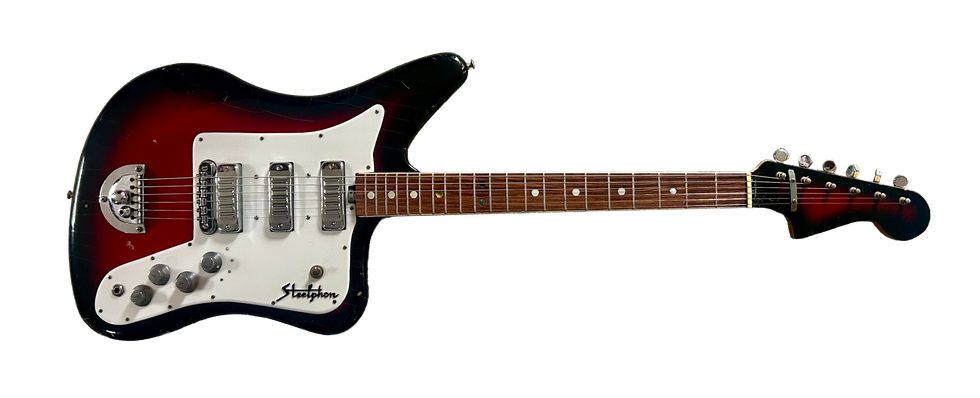
The next day (in real life), I went down to the basement to find this weird old bugger that, in my dream, would’ve made a good paddle. Apparently, this pancake-batter-shaped Steelphon is one of only a few known to exist, and I had forgotten that I still had it! Hailing from the mid ’60s, this Italian-made electric is a true oddity. Steelphon, which is an odd name in and of itself, was a company based in Turin, Italy, that was already making guitar-related items, primarily amps, but of course jumped into electric guitars during the boom years. The company seemed to contract out guitar production, because this one has all the characteristics of a Crucianelli-made guitar: the robust truss rod, the mini humbuckers, and the amazing bridge (which is like a steel brick) that would put any Gibson bridge to shame.
The amazing mini humbuckers are hot as hell and sound phenomenal—probably my all-time favorite pickups. The electronics feature a preset tone selector, pickup selector knob, and volume and tone knobbies. Playability is obviously weird because the body is so darn wide, and a little heavy. Plus, the neck is slightly thin so the whole experience is a little wonky. But again, the guitar sounds so good that it could be worth it for those looking for the “odd” factor.
Back in the day, I coveted this guitar for a long time. There was a fellow in the Netherlands who collected and sold the strangest guitars, and this was on his site forever. Eventually, I ended up buying this and a few others from him, but when I got this guitar, it was a basket case. Playability was awful, the electronics were a mess, and the fret dots seemed to have been repaired by a kindergartener. The Steelphon also suffered from the dreaded Italian finish-shrinkage, which caused the guitar to have a lot of finish checking and splitting, kind of like a candy-coated finish that got cracked.
All in all, we were able to sort everything out, and now the guitar plays rather well. A hallmark of many guitars from the ’60s is that the electronics were overly complicated. Designers back in the day were trying to get a lot of preset tonal options, but the overall sound was always getting muddied. Once you dive in under the pickguard, it’s always best to wire point-to-point to get the best sounding guitar—especially with these pickups, which are just so aggressive. They sound dreamy!
This four-pickup Teisco is our columnist’s most enduring source of inspiration.
Lately, I’ve been thinking about coaches and teachers—you know, the people in your life that have brought out the best in you. My daughter is now off to college, and my son is entering 10th grade, so I’ve been reflecting on our common experiences. My boy is playing sports and currently has a pretty good coach. The guy is supportive and involved, but still has a little "old-school" in him. When I was a kid, my coach was a “bucket” coach, meaning he brought a five-gallon bucket onto the field and flipped it over so he could sit and criticize everything we did wrong. He’d throw his hat and cuss and generally rule by intimidation! Times have certainly changed, brothers and sisters.
In my old age, I’ve come to learn that the best teachers and coaches were the ones who were excellent motivators: the people who could bring out the best in your performance and learning. Often, motivation comes from knowing that you’re seen and valued, even if you aren’t the sharpest knife in the drawer or the best athlete on the team. These types of people can be hard to find, but we all certainly remember them.
For me, it was Mr. Bryant in the 12th grade. He was a coach, a musician, and a phenomenal educator. I had just lost my dad before my senior year, and he totally tried to lift me up to keep playing sports and stick with guitar. He was a drummer but still had a fine guitar collection, and he would let me choose any one to play. He’d always ask which guitar “spoke” to me. Was it looks, feel, playability, sound, or something else? It’s like when Harry Potter’s wand found him, I suppose. So I ask you, faithful reader, which guitars speak to you? Which guitar gets you motivated to play, and which one inspires you as soon as you play it? Are you still on the hunt, or has your magic wand found you?
My most inspirational guitar is the early ’60s Teisco SS4L. Hailing from the beginnings of Teisco, the SS guitars were among the first to feature the now-famous gold-foil pickups. Of course, the 4L had a quartet of them! This is a guitar where everything is exaggerated to an absurd degree. The electronics feature four switches (pickup on/off) and multiple tone knobs and presets between the rhythm and lead circuits. The body is all out of whack, almost like a goofy-looking potato, and the headstock is elongated to excess. And then the chrome … like an old muscle car! The tremolo on this particular one is a very sophisticated floating unit that’s held together by string tension. Not the easiest to change the strings. These guitars came with one to four pickups and were primarily made from 1962–64. There is every flavor of sound in this guitar, something for every palette. Thin surf, raging blues, spaghetti western … you name it.
These SS4L guitars always inspire me to play because they offer all kinds of adjustments to the tone and tend to bring out the best in my playing. Normally, I’m a set-it-and-forget-it player. But with these guitars, it’s a chance to get creative, and the pickups add to the stew. The body feels kinda clunky and doesn’t balance very well, but the necks all have a nice, deep, full feel, often with a pronounced V-shape, which I totally dig.
I think I currently own four of these guitars, but the one pictured with this column is hanging right by my work bench to offer me a little motivation. I have plenty of nice guitars. Some play better, some feel better, and some sound better. But for whatever reason, I am drawn to this model, and that infatuation has lasted through the years. Oh, and you know what else? The “bucket” coach that I had still comes to watch football practice! He’s not always on a bucket these days, and he’s not yelling at anyone, but he’s still motivated.
This Japan-built Cipher Surfer offered something a little different than your average surf-rock instrument.
It’s about that time of the year when the family goes “down the shore,” as they say in my part of the world, for our annual vacation. We’ve been all up and down the East Coast shoreline, from Maine to South Carolina, but we usually settle in Delaware and all the quaint little escapes to be found.
Personally, I don’t really do much at the beach except meditate and people watch. Sometimes I don’t even bring a chair. Instead I just scoop out a “recliner” in the sand and ponder all sorts of musings. I’m fascinated by ocean living, and have wondered what it would be like to live at a house where you have to tie down your garbage cans so they don’t float away in a flood. At one point in our vacation we experienced a horrific thunderstorm and I had my son convinced that our car might float out into the ocean since we were right near the water. Good times!
So a few weeks ago, there I was on a Delaware beach thinking about life and how if I could choose to live anywhere or be anything, like a start-over, I think I would’ve enjoyed living along the shores of California and being a surfer. An idealized version, I suppose, but it seems cool in my mind. Of course I’d have to be 30 years younger, 50 pounds lighter, and operate with some semblance of balance, but hey, endless summers, baby!
In 1966 there was an awesome surfer documentary called The Endless Summer that chronicled a global search for the perfect wave. Director Bruce Brown’s film was filled with a cool soundtrack and the whole endeavor created a phenomenon of sorts which featured travel, music, culture, and a lifestyle that I just adore.
“Why would you associate a 12-string with surf music? The ’60s were different times.”
There were already plenty of surf bands at that time, such as the Ventures and Dick Dale, who embraced mostly instrumental music. That really appealed to fans around the world because the language barrier didn’t exist. And of course, there were a plethora of guitar ads that combined surfing with instruments. But sitting there in Delaware, I got to thinking about guitars that had “surf” in their name. There were newer models like the Charvel Surfcaster, but I was having a hard time coming up with vintage guitars. And then, just like a lightning strike during that coastal storm, it hit me … the Intermark Cipher Surfer from 1965!
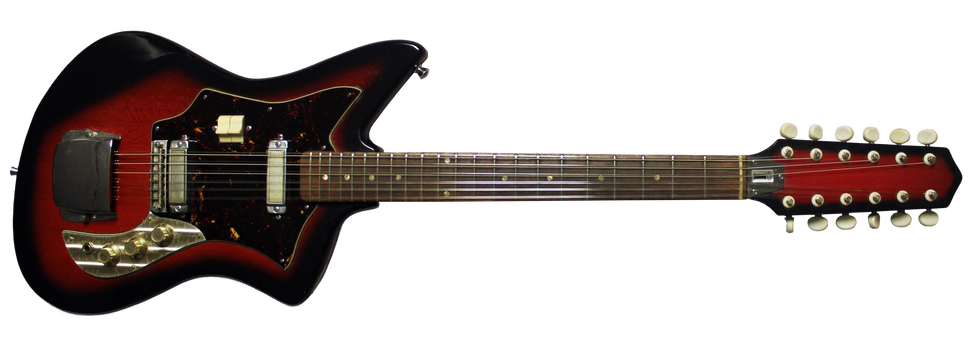
For about two years, the Shinko Gakki Company in Japan produced electric guitars in the Tatsuno Lake region (which is a great spot to visit). Shinko guitars were mostly sold in Japan but most of the electrics sold in the States were imported by the Intermark Corporation in New York. Intermark imported all sorts of stuff from Japan and often the Cipher name was attached to products. Hence, the long-ish Intermark Cipher guitars. There were all sorts of configurations, such as basses and 12-strings along with a number of pickup configurations and, sometimes, super-cool colors such as yellow, green bursts, and wonderful glitter finishes. Now the rub here is this: They labeled the 12-string the Surfer. Why would you associate a 12-string with surf music? The ’60s were different times.
The Surfer did turn out to be an excellent guitar anyway, mainly because Shinko really tried to make solid instruments when it came to build quality, and especially the great-sounding pickups. Modeled after Italian EKO units, Shinko decided to make these pickups a little stronger with the 12-string. The body shape is reminiscent of a curling wave, I suppose, with its exaggerated offset points. But the first thing I noticed when playing the guitar was that the neck was really robust. On some 12-strings I often find my fingers cramped on the fretboard, but the Intermark Surfer had plenty of room because the fretboard was wide and the neck was deep. I never worried about this guitar going out of tune. Two volumes and one tone knob were paired with simple on/off switches for each pickup, and an overall fine bridge was enough to make the Byrds play surf music!
There were already plenty of surf bands at that time, such as the Ventures and Dick Dale, who embraced mostly instrumental music. That really appealed to fans around the world because the language barrier didn’t exist. And of course, there were a plethora of guitar ads that combined surfing with instruments. But sitting there in Delaware, I got to thinking about guitars that had “surf” in their name. There were newer models like the Charvel Surfcaster, but I was having a hard time coming up with vintage guitars. And then, just like a lightning strike during that coastal storm, it hit me … the Intermark Cipher Surfer from 1965!
For about two years, the Shinko Gakki Company in Japan produced electric guitars in the Tatsuno Lake region (which is a great spot to visit). Shinko guitars were mostly sold in Japan but most of the electrics sold in the States were imported by the Intermark Corporation in New York. Intermark imported all sorts of stuff from Japan and often the Cipher name was attached to products. Hence, the long-ish Intermark Cipher guitars. There were all sorts of configurations, such as basses and 12-strings along with a number of pickup configurations and, sometimes, super-cool colors such as yellow, green bursts, and wonderful glitter finishes. Now the rub here is this: They labeled the 12-string the Surfer. Why would you associate a 12-string with surf music? The ’60s were different times.
The Surfer did turn out to be an excellent guitar anyway, mainly because Shinko really tried to make solid instruments when it came to build quality, and especially the great-sounding pickups. Modeled after Italian EKO units, Shinko decided to make these pickups a little stronger with the 12-string. The body shape is reminiscent of a curling wave, I suppose, with its exaggerated offset points. But the first thing I noticed when playing the guitar was that the neck was really robust. On some 12-strings I often find my fingers cramped on the fretboard, but the Intermark Surfer had plenty of room because the fretboard was wide and the neck was deep. I never worried about this guitar going out of tune. Two volumes and one tone knob were paired with simple on/off switches for each pickup, and an overall fine bridge was enough to make the Byrds play surf music!
My wife and I really enjoy living in the Northeast. Rolling hills, all four seasons, close to the coast, and plenty of day trip getaways to keep our summers busy and our vacations peaceful. One of our favorite haunts is Vermont and the town of Bennington. There are historical features there, such as the Bennington Battle Monument and the grave of the poet Robert Frost. Chiseled onto the face of his stone is the inscription, “I had a lover’s quarrel with the world.” This lovely, simple quote perfectly summarizes my relationships with guitars.
When I was young, I started taking lessons in Nazareth, Pennsylvania—right under the shadow of the Martin Guitar factory! I had all the inspiration in the world, and yet I would choose laziness and not practice. My mom would cancel my sessions, and then the itch to play would bubble up, and I’d be on a huge creative bender. This is how it went for most of my life. Fire and ice, playing and not playing. I probably should be an amazing player, but, alas, I remain a caveman. Part of the reason for that is I just don’t have a good ear and can’t carry a tune. My wife, on the other hand, is a music teacher and has incredible musical ability. She can play just about every instrument, even the wooden fifes sold at the Bennington Battle Monument! Seriously, she plays historical music on these primitive instruments while I’m messing around with the pop guns.
In my late teens and 20s, I really went on a creative spell and there was no stopping my insanity for guitar. This was also when I was buying old guitars and piecing them back together. I met Mike Dugan (the guy who plays guitar in all my videos) and started to join bands and go to open jams. Soon I found myself buying and selling guitars and looking for my “tone.” I guess we all go through this search at one time or another, but I just couldn’t be satisfied. For a while, I played a Univox Hi-Flier and then a nice Yamaha SG-1000. Eventually, I was running through guitars like water in a stream. Never ending.
Mike Dugan would always tell me, “When you know, you know,” but I just couldn’t figure it out. It wasn’t until I started hearing him play in my studio every week that I developed an ear for guitars. I mean, I still struggled tuning a guitar, but I could sense when a guitar had “it”—that zing, that bite, that crystalline quality that you could hear. Wood didn’t matter. Pickups didn’t matter. It just worked or it didn’t, and I wouldn’t be swayed. And the first guitar where I “knew” was this Kawai S160 dating to the early ’60s. The necks on these are huge, and the pickups have low output, but they all sound great. Really, I like all the Kawai electrics from the early days, but this one is my “one.”
Located in Hamamatsu, Japan, Kawai was making pianos before their foray into electric guitars. A lot of the early Japanese guitar makers lacked understanding of the guitar, but what they did have was lovely wood and experienced wood craftsmen. These guitars are robust and solid; they could hammer in fence posts! The truss rods don’t work at all, but the necks are so chunky that it doesn’t matter! And these early S-series Kawai guitars have some of the most beautifully figured rosewood that I’ve ever seen. Simply gorgeous.
The electronics are simple and easy to navigate with just one tone and volume pot, and one on/off switch for each pickup. The pickups handle overdrive or fuzz so well. These guitars also came in three- and four- pickup versions, and all sound fine. The tremolo pictured on mine is really the one to get, because it actually works well! Since most of the Kawai guitars were imported to Chicago, they were found in the hands of many bluesmen, including Hound Dog Taylor.
So my lover’s quarrel with guitars is a real thing. But some guitars just inspire you to play, or in my case, just make some noise. So how about you? Have you found your guitar? Your tone? It’s out there somewhere for you, and here’s hoping you find “the one” … or two!
source
Thanks for visiting our page. Don’t forget to go to our home page for more microtonal and indie music news.