Follow us
Ever since Adam heard the sound of Eve plucking the apple tree, men and women have been in search of new ways to create music. The first instruments were made from tree stumps, hollow gourds, and animal bones and horns. Over the centuries, the string, brass, and woodwind instruments that make up the traditional Western orchestra were developed, along with an array of keyboard and percussion instruments. Eastern cultures created their own instruments, like the sitar and tambura in India, the guzheng and erhu in China, and the djembe and kora in African countries. With the introduction of electricity came electric guitars, electric keyboards, and synthesizers.
Yet while these “standard” instruments were being created, there were odd music-makers who wanted unique sounds all their own. Some turned ordinary objects into musical instruments. Others modified traditional instruments in unusual ways. Three decades before John Cage inserted screws and bolts into a piano, the score for Erik Satie’s 1917 ballet “Parade” called for a typewriter, a foghorn, and a lottery wheel. Jazz musicians adopted rubber toilet plungers as brass mutes, and Rahsaan Roland Kirk played a garden hose as a flute. The Beatles used an old skiffle trick, blowing into combs wrapped in toilet paper for “Lovely Rita” on their 1967 album Sgt. Pepper’s Lonely Hearts Club Band. And Pat Metheny created an entire “orchestra” of acoustic mechanical instruments controlled by robots for his 2010 Orchestrion project.
Some musicians have built entire acts around combining humor with unusual instruments and unconventional tonalities. The roots of these acts can be traced to the burlesque and vaudeville shows of the early 1900s. With the birth of radio and, later, television, many of these acts became household names, selling millions of singles and albums and appearing in feature films. The trend has carried into this century, as funny and unusual musicians now go viral on YouTube and TikTok.
Frank Zappa, a musician who relished odd instrumentation, once asked, Does Humor Belong in Music? In the case of the following musicians, the answer is a resounding yes.
Lindley Armstrong “Spike” Jones was one of the first musicians to combine comedy with music performed on unusual instruments. Born in 1911, he grew up playing music and eventually became a drummer in dance orchestras. After growing bored playing the same arrangements night after night, he began collaborating with like-minded friends to create spoof arrangements and satires of popular songs and classical standards. He released his first recordings in the 1940s, landing his first broadcast hit with “Der Fuehrer’s Face,” a song ridiculing Hitler.
Over the years, Jones assembled “orchestras” that incorporated cowbells, car horns, gunshots, breaking glass, anvils, washboards, and rubber horns into his pop-song parodies. His comedic performances took him to radio, television, and even the movies. Many comedic musicians followed in his footsteps, from Stan Freberg to the Bonzo Dog Doo-Dah Band to Frank Zappa to “Weird Al” Yankovic.
The Blue Man Group burst onto the scene in 1987 when three close friends, Chris Wink, Matt Goldman, and Phil Stanton, wore blue masks and led a street procession that included the burning of a Rambo doll and a piece of the Berlin Wall. MTV’s coverage of the event drew attention to the group, and they were soon playing shows at downtown clubs. This eventually led to a full production at the Astor Place Theatre in 1991. Since then, a rotating cast of seventy “blue men” has performed all over the world, and the group has released several albums of original compositions.
Blue Man Group performs mute, with their skin painted blue. Watching a performance is like watching the Three Stooges, Marcel Marceau, and Kraftwerk all merged into one. They make use of unusual instruments, like the Chapman Stick, a 10- or 12-string bass guitar played by tapping; an electric zither, an 86-string instrument played with slides and finger picks; and a cimbalom, a hammered dulcimer.
The group invests an enormous amount of engineering and invention into creating new instruments. These include the drumbone, a series of connected pipes that can be moved to change pitch; the shredmill, an electro-mechanical sequencer that creates rhythmic loops; and paint drums, large tom-toms that splash paint as they’re played.
By the end of a Blue Man Group show, the Blue Men are covered in paint, the stage is littered with confetti, and the audience is covered in toilet paper. It’s a thrilling performance — one that pairs extraordinary musicianship with comedy.
The Boston Typewriter Orchestra formed in 2004. Its members dress in office attire and play manual typewriters as rhythm instruments, backed by satirical lyrics and deadpan office-culture comedy. The idea began when founder Tim Devin, gifted with a child’s typewriter at a bar, jokingly told an annoyed waitress he was “the conductor of the Boston Typewriter Orchestra” — and then actually formed one. The group performs in comically oversized ties, treating the typewriter as the entire gimmick of the act.
The band uses the keys, bells, and casing of the typewriter as percussion, but they’ve also modified their machines in unusual ways. One member added an optical sensor to a typewriter, transforming it into a theremin-like instrument that creates sound without physical contact. Another built a version of the African kalimba they call the “keylimba,” made from typebars, the metal rods that connect the keys to the letters on a typewriter.
In addition to their music videos, the Boston Typewriter Orchestra performs live, describing their shows as “part performance, part installation, part HR violation.”
Les Fo’Plafonds is a unique French musical and theatrical troupe that creates music using custom instruments made from 100% recycled everyday objects. Their name roughly translates to “The False Ceilings.” Like Blue Man Group, they’re a wonderful blend of comedic performers and genuinely talented musicians.
Les Fo’Plafonds was founded by Fabrice Guilbault in 2015. Guilbault, a percussion teacher, began turning everyday objects into instruments with a class of his percussion students; three of the founding members were music-school friends at the time. Today, the group consists of seven classically trained percussionists who also sing. They recreate well-known songs, replacing traditional instruments with pumps, bottles, frying pans, trash cans, saws, pipes, funnels, and much more.
Les Fo’Plafonds creates dynamic music videos where they perform well-known songs on their homemade instruments, with camera work as energetic as the music itself. In their live shows, the stage setup includes a makeshift kitchen, where musicians play mixers and pots and pans. They even fry hamburgers during a song, using the sizzle as another percussion sound.
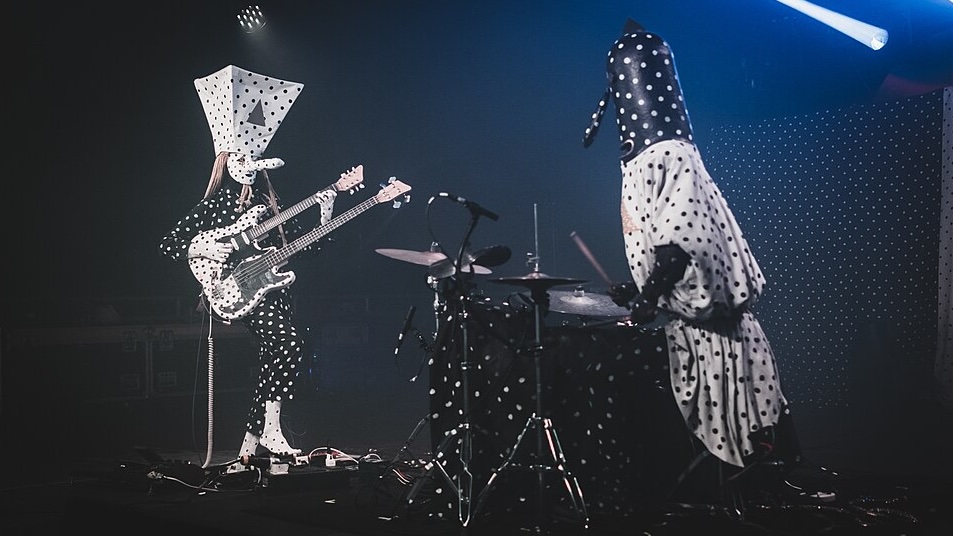
Angine de Poitrine became an internet sensation in 2026 thanks to their polka-dotted stage costumes and strange microtonal music. The masked duo from Quebec claim to be 333-year-old space travelers named Khn and Klek de Poitrine. In reality, they’re two extremely talented musicians who’ve been playing together since they were thirteen.
The duo released their first album in 2024 and went on to win Artist of the Year at 2025’s GAMIQ (Gala Alternatif de la Musique Indépendante du Québec) awards. But it was their live appearance on Seattle’s KEXP in December 2025 that turned them into a viral sensation.
Angine de Poitrine plays microtonal math rock. Math rock relies on complex rhythmic structures, including irregular stops and starts and odd time signatures; microtonal music uses notes that fall between the traditional Western twelve-tone scale. In performance, Khn masterfully plays a custom double-neck guitar while working his pedals barefoot, as Klek pounds the drums in precise synchronization. The duo also inject humor into their act through strange hand signals and guttural utterances that pass for “communication.”
From Spike Jones’s cowbell-and-gunshot orchestras in the 1940s to Angine de Poitrine’s masked, microtonal viral videos today, musicians have long found that laughter and unusual instruments make natural partners.
Whether it’s Blue Man Group’s engineered drumbones and paint-splattered showmanship, the Boston Typewriter Orchestra turning office equipment into a percussion section, or Les Fo’Plafonds building an act entirely out of recycled kitchenware, these performers share a common thread: real musical skill wrapped in genuine comedy. Nearly a century after the trend began, it shows no sign of slowing down, proving that Frank Zappa’s question — does humor belong in music? — has a clear and enduring answer.
-Scott Freiman
Photo: Angine de Poitrine by p_a_h, CC BY 4.0 <https://creativecommons.org/licenses/by/4.0>, via Wikimedia Commons
Scott Freiman is a composer, producer, musician, teacher, tech entrepreneur, and Beatleologist. In his copious spare time, he dreams up articles for CultureSonar. Sometimes, he actually writes them.
Your email address will not be published.
The answer to the title question is always, YES! 🤣
Naturally, we totally agree!
Absolutely! THE RESIDENTS, THE JAZZ BUTCHER, SNAKEFINGER, NEIL INNES (BONZO DOG DOO-DAH BAND), ARM OF ROGER (a hilarious one-off from GRANDADDY), CAPTAIN BEEFHEART, etc.
Absolutely! THE RESIDENTS, THE JAZZ BUTCHER, SNAKEFINGER, NEIL INNES (BONZO DOG DOO-DAH BAND), ARM OF ROGER (a hilarious one-off from GRANDADDY), CAPTAIN BEEFHEART, etc.
This one is just too good! Wonderful piece, Scott!
Yes, I am still laughing …….
I got into Zappa after attending a show at the old Virginia Beach Dome in 1971. It was the Flo and Eddie version of the Mothers of Invention and was the funniest show I had seen to that point. It was the show that Mark Volman and Howard Kaylin were arrested afterwards for using the “F-word” in “Billy the Mountain”.
On the crazy musical instrument side, look up Frank playing the bicycle on the Steve Allen Show on YouTube.
I love the appreciation of found or weird objects in music. Thank you Scott Freiman!
Don’t forget the short-lived band, Pianosaurus, who rocked-out originals and covers of songs like The Box Tops “The Letter” and “Chuck Berry’s “Memphis” on toy instruments. Their sole released album, 1987’s Groovy Neighborhood (produced by The dB’s Peter Holspapple) is a thing of beauty. They also recorded a second album, Back to School, which was never released (though the title track does appear in the film, New York Stories).
Good one, Stuart!
COPYRIGHT © 2026 – CULTURESONAR, INC. ALL RIGHTS RESERVED.
source
Thanks for visiting our page. Don’t forget to go to our home page for more microtonal and indie music news.