Arts & Culture
International
Politics
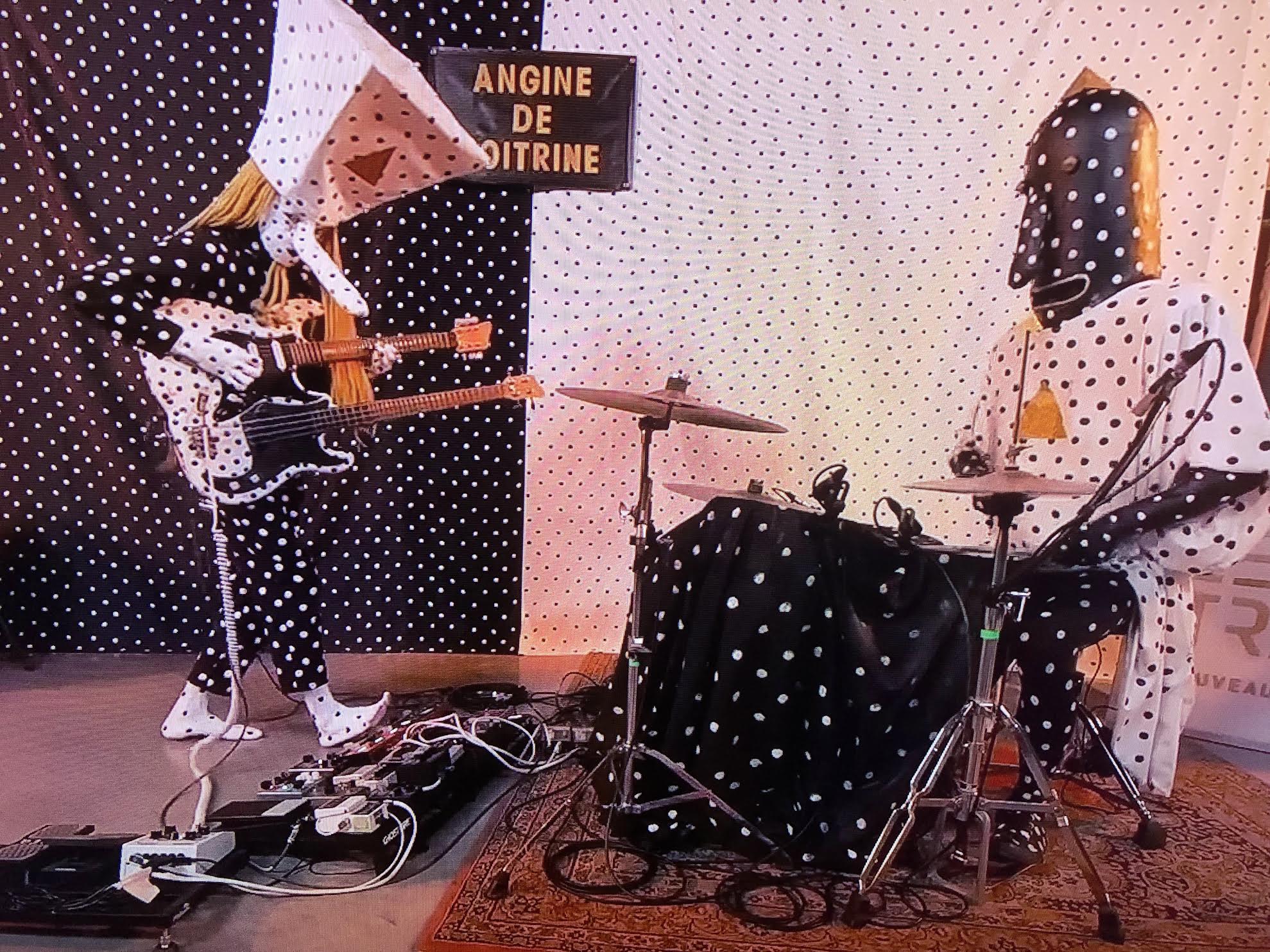
At first glance, Angine de Poitrine, who filled the grand Usher Hall with bouncing humanity last week, appear to be an exercise in anti-art provocation. Taking the stage in absurd, polka dot costumes and grotesquely outsized headpieces – part satirical reduction of stadium-rock bravado, part descendant of Hugo Ball’s 1916 cardboard-costumed declamations at Zurich’s Cabaret Voltaire – the pseudonymous Quebec duo invite the uninitiated to dismiss them as theatrical punk. To stop at the visual surface, however, is to miss some music of uncompromising formal sophistication in the twisted fresh genre the band have created and made unfeasibly popular by becoming a YouTube sensation over the past year. Namely, neo-Dadaist microtonal math rock.
The theatrical disguise is not mere gimmickry. It operates as a protective, estranging mask (an Affekt-Maske) that strips the performance of familiar rock ego and locates it within the lineage of early twentieth-century avant-garde performance art. Just as Ball, Tristan Tzara, and Jean Arp used nonsense phonetics and rigid geometric staging to dismantle the bourgeois rationalism that led to the First World War, Angine de Poitrine deploy absurdism to alienate the listener from the passive, commercialised expectations of contemporary pop culture and aural AI slop. This mask forces listeners to engage directly with the physical mechanics of sound.
For an audience grounded in Western classical traditions (only a small number of whom were likely part of this audience at Usher Hall, one of a series of Angine de Poitrine Psychfest gigs), the true fascination lies in the radical friction between this Dadaist, drive-it-home surface and its underlying compositional architecture. What initially hits the ear as a hard-driving riff quickly reveals itself as a constellation of microtonal inflections and intricate metric constructions.
Where conventional rock rests comfortably within equal temperament – the 18th-century compromise that divided the octave into twelve uniform semitones, flattening natural harmonics to facilitate key modulation – Angine de Poitrine violently re-open the acoustic spaces between those pitch points.
To realise this live, Khn de Poitrine utilises a custom, hand-built double-neck hybrid guitar and bass designed specifically to handle the physical demands of 24-EDO (24 Equal Division of the Octave) performance. Rather than cluttering the entire fretboard with identical quarter-tone frets, the neck features strategic, selective fretting. Microtonal frets are inserted into specific areas, allowing the player to strike conventional 12-TET power-chords with one hand position, then shift laterally into strict quarter-tone intervals without losing physical velocity.
The instrument also houses two distinct electronic circuits. The lower bass neck passes through pitch-octavers, distortion, and active equalization to drive a wall of low-end amplifiers, while the upper guitar neck routes through high-gain filters to highlight upper-register micro-intervallic friction. Using foot-controlled phrase samplers, microtonal guitar fragments are recorded live, looped, and phase-shifted. This allows a single performer to construct dense, microtonal contrapuntal lattices over which the drums can execute complex, non-isometric meters, while also inserting more familiar backbeats.
These microtonal inflections do not function as ambient colour or exotic ornament. Instead, they operate as structural tension, bending away from equal temperament into pitch fields that recall Harry Partch’s just-intonation experiments or György Ligeti’s micro-intervallic shifts. When paired with high-gain distortion, these quarter-tones generate intense acoustic interference patterns (a literal, physical beating in the air) forcing the ear to re-evaluate what it has been conditioned to dismiss as “out of tune.”
Rhythmically, the engine owes something to Igor Stravinsky’s additive phrasing or Elliott Carter’s metric modulations, as well as to standard rock meters. Piles of shifting time signatures, phase-displaced accents, and relentless polyrhythmic loops collide over an unyielding, primal pulse. It is precisely this disjuncture between Dadaist visual nonsense, hard-hitting punk riffs, custom mechanical innovation, and careful mathematical control that makes the work so vital. Also, of course, it can rock like crazy and provide just enough incentive to attempt to dance that mostly grown men and women will occasionally risk throwing their limbs about, with or without chemical assistance.
The result live, as in Edinburgh, is strangely joyous and addictive. Angine de Poitrine bridge the gap between concert hall, cabaret, rock gig, and club floor. It is delightfully irreverent, happy, off-kilter but intelligent music stripped of institutional dryness, full of heat, danger and wit. Also, of course, it sticks two fingers up to AI, which could never come up with something as algorithmically unpredictable. This, along with an endless stream of online analysis, is probably part of the explanation as to why it has become so (to use an archetypally crusty word) hip.
Your email address will not be published.
Surely it conveys some emotional feeling , compared to other genres (blues, folk, jazz, rock…)
Does it ?
Perhaps that doesn’t matter
But it’s definitely another kettle of fish
We don’t take any advertising, we don’t hide behind a pay wall and we don’t keep harassing you for crowd-funding. We’re entirely dependent on our readers to support us.
Don’t miss a single article. Enter your email address on our subscribe page by clicking the button below. It is completely free and you can easily unsubscribe at any time.
Our new website is here and we’re keen to hear any feedback
source
Thanks for visiting our page. Don’t forget to go to our home page for more microtonal and indie music news.